
Fan-assisted heat exchanger for industrial processes
A fan-assisted unit is an industrial heat exchanger with forced ventilation that enables the cooling or heating of process fluids using ambient air, ensuring high thermal efficiency, operational stability, and reliability in critical industrial environments.
Cluster of forced-ventilation heat exchangers for demanding industrial applications
Fan-assisted units constitute a family of air-to-fluid thermal exchange systems designed to optimize energy transfer between a process fluid and air through forced convection. Their architecture allows continuous operation, variable loads, and performance under severe environmental conditions, while maintaining precise thermal control and controlled operating costs.
This type of equipment is particularly suitable for industrial processes requiring cooling, heating, or thermal dissipation without water consumption, offering a high level of mechanical robustness and long service life.
Operating principle of fan-assisted units
The operation of a fan-assisted unit is based on the forced circulation of air by means of axial or centrifugal fans through a heat exchange coil.
The process fluid (water, water-glycol, thermal oils, or other industrial fluids) flows inside the tubes of the heat exchanger, while ambient air passes over the exterior of the coil, promoting efficient heat transfer by forced convection.
This principle allows:
- Increasing the overall heat transfer coefficient.
- Reducing the required heat exchange surface area.
- Ensuring thermal stability under variable loads.
- Operating in open or closed systems depending on the application.
Types of fan-assisted units
Within the cluster of fan-assisted equipment, different configurations are included, each optimized for a specific industrial function: cooling process fluids, heating air, or dissipating large thermal loads.
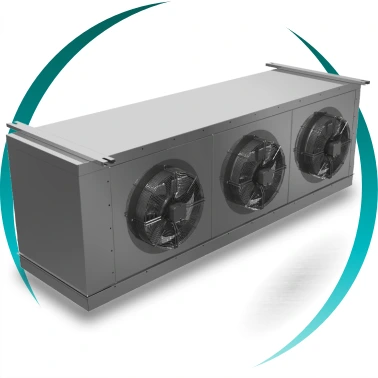
Air cooler
Heat exchange unit designed for cooling process fluids using ambient air, without water consumption.
Main characteristics
Heat exchanger with forced ventilation for cooling process fluids.
Use of ambient air as the thermal dissipation medium.
Operation in a closed circuit (water, water-glycol, thermal oils, etc.).
Designed for continuous operation and variable thermal loads.
Low maintenance and independence from water consumption.
Option to incorporate adiabatic systems to increase cooling capacity under severe environmental conditions.
Typical applications
Cooling of industrial process water.
Cooling circuits for machinery and production equipment.
Processes in the food, chemical, and pharmaceutical industries.
Energy facilities and auxiliary systems.
Processes requiring thermal stability and high operational reliability.
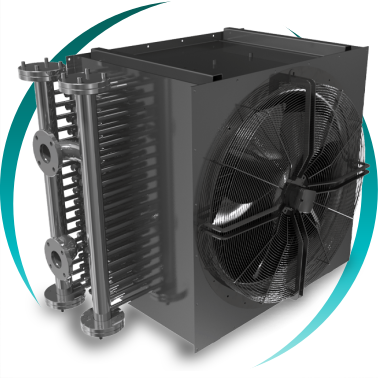
Aerothermo
Industrial air heating unit that transfers heat from a thermal fluid to the environment by means of forced ventilation.
Main characteristics
Air heating unit with integrated fans.
Heat transfer from fluids such as hot water, steam, or thermal oil.
Uniform heat distribution in large volumes.
Fast thermal response and simple control.
Compact design adaptable to different installation configurations.
Typical applications
Heating of industrial buildings and warehouses.
Logistics spaces, production areas, and workshops.
Facilities with large air volumes.
Processes requiring thermal comfort or maintenance of ambient temperature.
Industrial and tertiary HVAC systems.
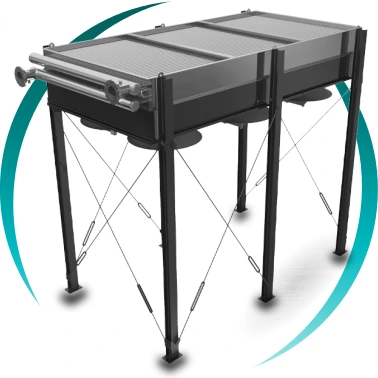
Dry cooler / Aerorefrigerator
Air-to-fluid heat exchanger designed for the continuous dissipation of large thermal capacities in critical industrial environments.
Main characteristics
Equipment intended for dissipating large thermal loads.
Air-to-fluid heat exchanger with high airflow rate.
Designed to operate under severe industrial conditions.
High mechanical robustness and long service life.
Modular and scalable configurations.
Suitable for continuous and critical operation.
Typical applications
Cooling of high-power industrial processes.
Dissipation of waste heat in power plants.
Heavy and metallurgical industry.
Data centers and critical infrastructures.
Systems where reliability and redundancy are decisive.
When to choose an air cooler, an aerotherm, or a dry cooler
Air cooler: when the main objective is to cool a process fluid using ambient air and minimize water consumption.
Aerotherm: when it is necessary to heat air and distribute heat uniformly in industrial spaces.
Dry cooler: when large thermal capacities must be dissipated continuously and reliably in critical processes.
Materials and construction configurations
Fan-assisted units can be manufactured in a wide range of materials, selected according to the fluid, operating conditions, and regulatory requirements:
- Carbon steel
- Stainless steel
- Copper
- Aluminum
- Cupronickel
- Titanium
This construction flexibility allows the equipment to be adapted to corrosive environments, high pressures, elevated temperatures, or sanitary and food-grade applications.
Industrial sectors and applications
Fan-assisted units are used across multiple industrial sectors:
- Food and beverage industry
- Chemical and petrochemical industry
- Pharmaceutical and biotechnology industry
- Energy, oil, and gas
- Plastics industry and materials processing
- Drying processes and thermal treatments
- Wastewater treatment
- Cold chain, transport, storage, and distribution
- Industrial and tertiary HVAC
- Heavy and metallurgical industry
- Data centers and critical infrastructures
Accessories and functional options
Fan-assisted units can incorporate different accessories to adapt to each process:
- Condensate collection trays
- Air filters
- Safety guards
- Automatic cleaning systems
- Adiabatic systems
- Speed control and energy regulation
Key advantages of fan-assisted units
High efficiency in heat transfer.
Reliable operation in continuous duty.
Reduction of overall energy consumption.
Modular and scalable design.
Adaptability to multiple fluids and process conditions.
Simple maintenance and long service life.
Modular
High capacity
Efficiency
Industrial processes
FAQs
What is a fan-assisted unit?
A fan-assisted unit is an industrial thermal exchange system that uses air driven by fans to transfer heat between a process fluid and the environment.
It consists of a heat exchange coil and one or more fans that generate forced convection. This configuration enables high heat transfer capacities, operation under variable loads, and ensures operational stability in continuous or critical industrial processes.
What is a fan-assisted unit used for in industry?
It is used to cool, heat, or dissipate thermal energy in industrial processes.
Fan-assisted units are applied in process fluid cooling circuits, heating of industrial spaces, dissipation of waste heat, and thermal control of critical installations. They stand out for their reliability, low maintenance, and independence from water consumption.
What is the difference between an air cooler, an aerotherm, and a dry cooler?
The main difference lies in their function: cooling fluids, heating air, or dissipating large thermal capacities.
The air cooler is optimized for cooling process fluids using ambient air. The aerotherm is designed to transfer heat from a fluid to air for heating purposes. The dry cooler is intended for the continuous dissipation of large thermal loads in critical industrial processes.
What advantages do fan-assisted units have compared to other systems?
High efficiency, lower water consumption, and reduced maintenance.
Compared to evaporative or open-circuit systems, they provide more stable operation, lower dependence on water resources, better temperature control, and a long service life, which reduces the total cost of ownership.
Can fan-assisted units be customized according to the process?
Yes, they can be fully adapted to each industrial application.
The units can be configured in terms of capacity, geometry, materials, fan type, and accessories, allowing performance optimization according to actual operating conditions and the specific requirements of the process.