
Liquid-liquid heat exchanger for industrial processes
A liquid-liquid heat exchanger is an industrial piece of equipment that transfers thermal energy between two liquid streams without mixing them, controlling temperature, optimising energy consumption and protecting the process. It is the most frequent heat transfer operation in the chemical, pharmaceutical, food, petrochemical and energy industries.
The choice of technology is not a catalogue exercise. Each combination of fluids, pressures, viscosities and maintenance requirements leads to a different solution. This page is the central node of the BOIXAC liquid-liquid heat exchange cluster: it provides a global overview of selection criteria and leads to the four child technologies, where constructive and application details of each are developed.
When a liquid-liquid heat exchanger is used
- Cooling process water or service fluids with mains water, cooling tower or glycol
- Heating a process fluid with condensed steam, hot water or thermal oil
- Recovering energy from a hot stream to a cold stream in the same process
- Maintaining service temperatures in hydraulic systems, compressors and transformers
- Temperature control in reactors, fermenters and batch processes
- Pasteurisation, sterilisation and thermal treatments in the food and pharmaceutical industry
The four BOIXAC liquid-liquid heat exchange technologies
| Technology | Viscosity range | Max. pressure | Fouling admitted | Maintenance | When to choose it |
|---|---|---|---|---|---|
| Concentric tubes | High — very high | High (>40 bar) | High / sediments | Dismantlable | Viscous fluids, pastes, sediments, low flow rates |
| Multitube tubular | Moderate — high | High (>100 bar) | Moderate / fibres | Direct cleaning | Difficult fluids, Newtonian and non-Newtonian, high flow rates |
| Shell and tube | Low — moderate | Very high (>300 bar) | Low — moderate | Bundle pull-out | High pressure, large capacity, oil & gas, energy |
| Gasketed plate | Low — moderate | Moderate (≤25 bar) | Low (clean fluids) | Easy access | Clean fluids, limited space, easy cleaning, high efficiency |
Initial indicative selection. The definitive technology is determined by specific thermal and mechanical analysis for each project.
Liquid-liquid heat exchanger selection criteria
Viscosity and rheological behaviour of fluids
Viscosity is the factor that most determines technology selection in liquid-liquid heat exchange. Low-viscosity fluids (water, glycol, light solvents) work well in gasketed plate or shell-and-tube heat exchangers. High-viscosity fluids (oils, margarines, chocolate paste, polymers, sludges) require tubular or concentric tube heat exchangers, where the free passage is sufficient and the transfer coefficient can be maintained at appropriate fluid velocities.
Service pressure and PED regulation
High-pressure applications (>40 bar) require tubular or shell-and-tube constructions. Gasketed plate heat exchangers are limited by gasket and frame resistance, typically up to 25 bar. For extreme pressure applications (>100 bar), shell-and-tube construction or thick-walled tubular systems are the only viable option.
Fouling tendency and presence of particles
Fluids with high fouling tendency (sludges, calcium-rich fluids, oils with particles, polymerising fluids) require geometries with wide free passage and easy access for cleaning. Concentric tube and multitube tubular heat exchangers offer the greatest free passage and most direct mechanical cleaning.
Sanitary and hygiene requirements
In food, pharmaceutical and biotechnology industries, the heat exchanger must meet hygiene requirements including dead-zone-free surfaces, CIP/SIP compatibility and electropolished AISI 316L materials.
Thermal capacity and temperature differential
High thermal capacity applications (>1 MW) are best addressed with shell-and-tube heat exchangers or batteries of tubular exchangers in series. Moderate capacity applications with small temperature differentials (ΔT <10°C) are better suited to gasketed plate heat exchangers, which offer the highest overall transfer coefficient (U).
Available space and installation constraints
Gasketed plate heat exchangers offer the highest surface density per equipment volume. Shell-and-tube heat exchangers require additional space for tube bundle extraction during maintenance.
Life cycle costs: purchase, operation and maintenance
The initial cost is not the only relevant factor. A plate-and-gasket heat exchanger may be the most economical to purchase but the most expensive to maintain if the fluid is fouling. A shell-and-tube heat exchanger may have a high initial cost but a significantly longer service life with minimal maintenance. BOIXAC analyzes the total life-cycle cost to help make the right decision.
Industrial applications of liquid-liquid heat exchange
Food and beverage industry
Pasteurisation of milk, juices, beer and low-viscosity beverages in high-efficiency gasketed plate heat exchangers. Cooling and heating of viscous products such as margarines, chocolates, caramels, vegetable oils and creams in tubular or concentric tube heat exchangers.
Chemical and pharmaceutical
Temperature control in continuous and batch reactors with corrosive chemical fluids in special material heat exchangers (Hastelloy, titanium, duplex). Condensation of process vapours and cooling of reaction streams.
Oil, gas and petrochemical
Cooling of petroleum-derived products at high pressure in ASME-compliant shell-and-tube heat exchangers (U-STAMP not included). Heat recovery from waste streams in refineries and natural gas processing plants. Heating of viscous crude oils to facilitate transportation and processing.
Energy and industrial HVAC
Thermal exchange between energy distribution circuits and process circuits. Cooling of compressor oil, hydraulic systems and electrical transformers. Waste heat recovery in cogeneration plants.
Water treatment and heavy industry
Cooling and thermal treatment of sludges and wastewater with high solids concentration in multitube tubular heat exchangers. Thermal management in metallurgical and mineral processing plants.
The four child technologies: selection guide
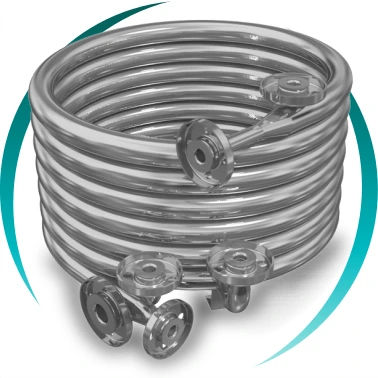
For highly viscous fluids, pastes, sediments, and low flow rates. Removable and easy to clean. Suitable for high-pressure applications. Ideal for challenging products that other technologies cannot handle effectively.
View technology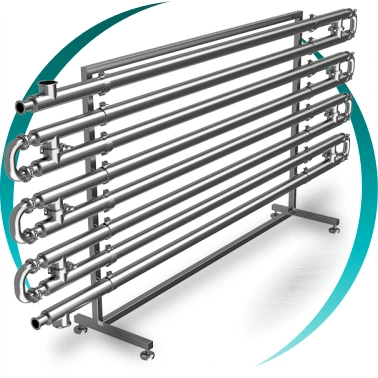
For Newtonian and non-Newtonian fluids, fibres, sediments and high pressure at moderate or high flow rates. Dismantlable, mechanically cleanable. Very wide viscosity range.
View technology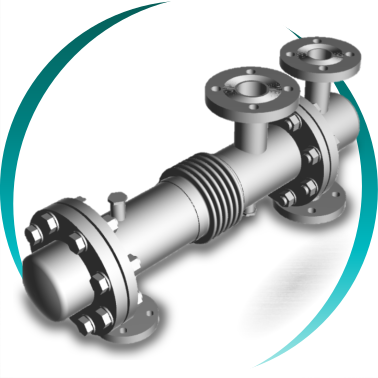
For high pressure, large thermal capacity and oil, gas and energy applications. ASME-compliant construction available. Long service life in continuous operation.
View technology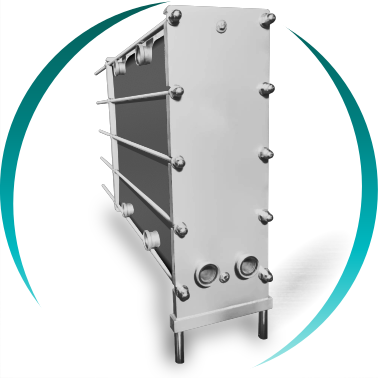
For clean fluids, low or moderate viscosity and maximum thermal efficiency in limited space. Dismantlable for cleaning and capacity expansion. Maximum U coefficient.
View technologyFrequently asked questions about liquid-liquid heat exchangers
What is the difference between a plate heat exchanger and a shell-and-tube heat exchanger?
Plates offer higher efficiency in limited space; shell and tube resists extreme pressures and difficult fluids.
The difference is fundamentally structural and determines the application range of each. The gasketed plate heat exchanger transfers heat through closely spaced metal plates generating a very high transfer coefficient (U), is compact and easy to dismantle, but gaskets limit it to pressures below 25 bar and particle-free fluids. The shell-and-tube heat exchanger transfers heat between the fluid flowing through the tubes and the fluid flowing through the shell (outside the tubes), admittes much higher pressures, corrosive fluids, special materials, and continuous operation over long periods.
For what fluids is a concentric tube heat exchanger suitable?
Especially for very viscous fluids, pastes, thick sediments and difficult food products at high pressure.
The concentric tube (or coaxial) heat exchanger is the preferred solution when the fluid is so viscous or so prone to fouling that no other technology can achieve equally efficient heat transfer. Typical applications include: heavy vegetable oils, margarines, chocolate and cocoa pastes, candies and nougat, products from the heavy chemical industry, concentrated pharmaceutical creams, and mining slurries.
When is the multitube tubular heat exchanger preferable to the concentric tube?
When the flow rate is higher, the fluid contains fibres or sediments and direct mechanical cleaning of the tube interior is needed.
The multitube tubular heat exchanger is the natural evolution of the concentric tube for larger flow rates and fluids with dispersed particles, fibres or sediments. The parallel multi-tube configuration increases flow rate without increasing pressure drop. The modular and dismantlable BOIXAC design allows direct access to the interior of each tube for mechanical cleaning.
Which liquid-liquid heat exchanger is best for the food industry?
Depends on product viscosity: gasketed plate for clean fluids and tubular or concentric for viscous or particulate products.
There is no single “best” heat exchanger for the food industry because the product and condition range is very wide. For clean low-viscosity fluids (milk, juice, beer, water), gasketed plate heat exchangers offer the highest thermal efficiency with the easiest CIP cleaning. For viscous products (margarines, chocolate, caramels, fruit puree), BOIXAC multitube tubular or concentric tube heat exchangers offer the necessary free passage. Depending on the project, BOIXAC can supply electropolished AISI 316L equipment compliant with EHEDG, HACCP and FDA requirements.
How is a liquid-liquid heat exchanger sized?
Using the thermal balance (power, flow rates, temperatures), fluid properties and the overall transfer coefficient U of the selected technology.
Sizing requires: (1) Determine required thermal power (Q = m·cp·ΔT for each fluid). (2) Calculate the Log Mean Temperature Difference (LMTD). (3) Estimate the overall coefficient U for the technology and fluids. (4) Calculate exchange area (A = Q / U·LMTD). (5) Verify pressure drop and fluid velocities. BOIXAC can perform this calculation and provide the properly sized solution together with the complete technical documentation.
Can a liquid-liquid heat exchanger work with corrosive fluids?
Yes, with the right material selection: stainless steel, titanium, Hastelloy or duplex depending on the fluid and standards.
Yes. For slightly corrosive fluids, AISI 316L is sufficient. For moderately aggressive acid or alkaline fluids, AISI 316L with appropriate thicknesses or titanium may be used. For highly aggressive fluids (hydrochloric acid, concentrated sulphuric acid, halogens, brines), BOIXAC sizes with Hastelloy C-276, titanium or duplex/superduplex steels.
Liquid-liquid heat exchange projects executed by BOIXAC
- Multitube tubular heat exchanger for viscous fluid treatment in the biofuels industry, in dismantlable AISI 316L with certified CIP cleaning
- Heat exchanger for high-pressure oil cooling at a Barcelona metallurgical plant, ASME Section VIII compliant, 3,603 kW capacity
- Concentric tube heat exchangers for margarine and butter fluidisation in the food industry, at 85°C and 12 bar service pressure
- Battery of gasketed plate heat exchangers for heat recovery at an industrial wastewater treatment plant, 120 m³/h flow rate and 8°C temperature differential
Do you need a liquid-liquid heat exchanger for your process
The BOIXAC technical team analyses the fluids, process conditions, regulatory requirements and installation constraints, and proposes the most suitable liquid-liquid heat exchange technology.
We work with plant engineers, process managers and OEM equipment manufacturers across Europe.