
Solid-liquid heat exchanger for industrial processes
A solid-liquid heat exchanger is an industrial unit designed to transfer thermal energy between a heat transfer fluid and a product containing solids, particles, fibers, granules, or heterogeneous phases, providing efficient and safe thermal control while minimizing the risk of blockage and product degradation.
In processes where the product is not entirely liquid, conventional industrial heat exchangers fail through fouling, blockage or mechanical damage to the product. The solid-liquid heat exchanger solves exactly this challenge: transferring heat efficiently and reliably when the solid phase is part of the process, not an exception.
This page is the central node of the BOIXAC solid-liquid heat exchange cluster. It provides a global overview of the process challenge and selection principles, and leads to the pillow plate heat exchanger page, which is the primary technology BOIXAC uses for this family of applications.
The challenge of thermal exchange with solids
In industrial production, many processes involve products that cannot be treated as pure fluids: food granulates (green coffee, rice, seeds, sugar), industrial sludges, particle-laden suspensions, pasty or semi-viscous products, organic waste in fermentation, molten polymers or bulk mineral materials. In all these cases, the industrial heat exchanger must meet conditions that no standard technology can simultaneously guarantee:
- Wide, clean thermal contact surface with no dead zones where solids accumulate
- Mechanical resistance to contact with abrasive particles or fibres
- Geometry that does not compress or degrade the solid product
- Compatibility with CIP/SIP cleaning and sanitary requirements where applicable
- Maintained thermal efficiency over time, despite fouling
At BOIXAC, we engineer each solid-liquid heat exchange solution from real process analysis: nature of the solid, particle size and distribution, viscosity of the liquid phase, working temperature and pressure, and cleaning requirements. We do not propose a solution until we fully understand the challenge.
Solid-liquid heat exchange technologies
Pillow plate heat exchanger for bulk solids and immersed products
Pillow plate technology is the primary solution BOIXAC develops and supplies for solid-liquid heat exchange. It is based on metallic plates with an optimised relief geometry that generate a large contact area surface, high thermal transfer and minimal residue accumulation.
The pillow plate is used in two configurations for solid-liquid applications: immersion (the plate is in direct contact with the product inside a tank or reactor) and external contact (the moving product flows over the surface of the pillow plate). This versatility makes it one of the few heat exchanger technologies capable of efficiently handling heat transfer for both bulk solids and products containing suspended particles.
The complete detail of the pillow plate technology, its construction, technical parameters, material compatibility and sector applications are developed on the pillow plate heat exchanger page.
Immersion heat exchanger in tank or reactor
The immersion heat exchanger operates submerged directly inside the tank or reactor containing the product. The heat transfer fluid circulates inside the exchanger while the solid-containing product surrounds the outer surface. This configuration is particularly suitable for batch processes, fermentation, maturation or thermal treatment of discontinuous products where fluid circulation is not practical or desirable.
Tank thermal jacket for viscous products with solids
The thermal jacket wraps around the outside of the tank and transfers heat through the wall. It provides homogeneous temperature control across the entire content, with no element in contact with the product. Indicated for chemical reactions with suspended solids, controlled crystallisation and processes where product integrity admits no internal surface.
Solid-liquid heat exchanger selection principles
| Parameter | Critical consideration | Impact on selection |
|---|---|---|
| Nature of the solid | Granulate, fibre, particle, sludge, crystal | Surface geometry and minimum free passage |
| Particle size | From microns to centimetres | Opening tolerance and blockage risk |
| Solids concentration | % by weight or volume | Actual transfer coefficient and fouling |
| Liquid phase viscosity | Newtonian or non-Newtonian fluids | Flow regime and pressure drop |
| Working temperature | Range and thermal gradients | Material, wall thickness and PED compliance |
| Service pressure | Internal pressure of heat transfer fluid | PED category and structural construction |
| Sanitary requirements | CIP/SIP, traceability, food regulations | Surface finish, access points and materials |
| Product fragility | Solids that cannot be compressed or crushed | Flow velocity and geometry without mechanical pressure |
Analysis of these parameters determines whether the optimal solution is an immersion pillow plate, a standard immersion heat exchanger or a thermal jacket. BOIXAC conducts this study before proposing any solution.
Industrial applications of solid-liquid heat exchange
Food and beverage industry
Cooling of cereals, seeds, green coffee, rice and nuts after thermal processing. Refrigeration of semi-processed dairy products, macerates, juices with pulp and beverages with solids in suspension. Temperature control during beer and wine fermentation with active yeast. Flake ice production for food refrigeration and cold chain logistics.
Chemical and pharmaceutical
Thermal treatment of crystal suspensions in controlled crystallisation processes. Heating or cooling of exothermic reactions with solid catalysts. Temperature control in polymerisations with particles. Treatment of activated sludge in biological treatment processes.
Energy and biomass
Cooling of granulated biomass or pellets before storage. Heat recovery from particle-laden waste streams in cogeneration plants. Thermal treatment of wet industrial solid waste to facilitate management.
Paper, mining and heavy industry
Cooling of sands, cements, mineral or metallic products in bulk with high process outlet temperatures. Thermal management of mining sludges and mineral species in hydrometallurgical treatment. Temperature control in paper mill sludge tank processes.
Benefits of the BOIXAC solid-liquid heat exchanger
- Efficient thermal transfer in the presence of solids, without blocking or damaging the product
- Fully custom design, adapted to the nature and size of the solid in each process
- Materials selected for chemical compatibility, temperature and applicable standards (PED, food, pharmaceutical)
- High contact area geometries with minimal residue accumulation
- Compatibility with CIP and SIP cleaning in sanitary applications
- Extended service life thanks to mechanical resistance to abrasion and fouling
- Direct integration into existing tanks, reactors or product lines without modifying the plant layout
The pillow plate technology: primary solution for solid-liquid exchange
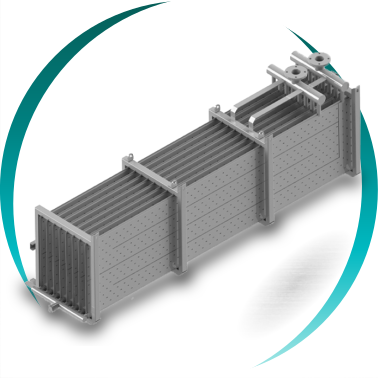
External contact surface for bulk solids in motion. Coffee, sugar, seeds, sand, cement and minerals. Cooling without fluid contact with the product.
View technologyFrequently asked questions about solid-liquid heat exchangers
Can a conventional heat exchanger work with products containing solids?
Not for actual solids. A standard gasketed plate-and-frame heat exchanger blocks with particles above 0.5–1 mm.
Generally not reliably. Conventional gasketed plate heat exchangers, small-diameter tubular units and shell-and-tube units with narrow passages block or degrade with products containing particles, fibres or solids of significant size. Fouling reduces the transfer coefficient, increases pressure drop and forces unplanned shutdowns. The solid-liquid heat exchanger — especially the pillow plate — has been specifically designed to operate with heterogeneous products without the limitations of standard equipment. Correct selection of geometry, free passage and materials is the key to reliable long-term operation.
What products with solids can be cooled or heated with a pillow plate heat exchanger?
Food granulates, dairy products, sludges, crystal suspensions and bulk minerals, among many others.
The range of applications is very broad: food granulates (green coffee, rice, seeds, sugar, cereals), dairy products with particles (fresh cheese, yoghurt), beverages with pulp or active ferments (beer, wine, orange juice), crystal suspensions (sucrose, sodium chloride, citric acid), industrial sludges (wastewater, paper mills), minerals and bulk materials (sand, cement, salt, fertilisers). In each case, BOIXAC adapts the pillow geometry and material to the specific characteristics of the solid: size, shape, abrasivity and chemical compatibility.
What is the difference between a solid-liquid heat exchanger and a thermal jacket?
The solid-liquid heat exchanger transfers heat in direct contact with the product; the jacket operates through the tank wall.
The difference is the point of thermal contact. In an immersion heat exchanger or a pillow plate in direct contact, the exchange surface is the exchanger itself, in physical contact with the product. In a thermal jacket, the heat transfer fluid circulates outside the tank and transfers heat through the metallic container wall, with no additional element inside the product. The jacket is preferred when product integrity admits no internal elements, when the content is too abrasive for thin metallic plates, or when temperature uniformity is a higher priority than transfer speed.
Do BOIXAC solid-liquid heat exchangers comply with food and pharmaceutical regulations?
Yes. AISI 316L materials, electropolished finishes and CIP/SIP compatibility in line with FDA, EHEDG and HACCP.
Yes. BOIXAC supplies solid-liquid heat exchangers manufactured in electropolished AISI 316L, with dead-zone-free geometries compatible with CIP cleaning and SIP sterilisation. Equipment for food and pharmaceutical applications includes material traceability documentation, weld quality certificates and surface roughness reports (Ra ≤ 0.8 μm typically) in accordance with EHEDG, FDA 21 CFR and HACCP standards. For applications requiring PED certification, BOIXAC manages the categorisation and complete technical documentation during the design phase.
How is the size of a solid-liquid heat exchanger determined for a specific process?
Through specific thermal calculation: required power, temperature gradient, fluid properties and available geometry.
Sizing a solid-liquid heat exchanger cannot be done from standard catalogues because the actual transfer coefficient depends on solids concentration, liquid phase viscosity, particle size and flow regime, which vary significantly between processes. BOIXAC offers specific thermal calculations for each project: determines required thermal power, selects the geometry and number of plates or the immersion configuration, verifies mechanical resistance and compliance with regulatory requirements. Contact the BOIXAC technical team to begin analysis of your process.
Can the pillow plate replace a conventional plate heat exchanger in existing installations?
In many cases, yes. The pillow plate can be adapted to existing tanks and reactors without modifying the layout.
In many industrial installations, it is possible to replace a conventional gasketed plate heat exchanger (failing through fouling or blockage) with a pillow plate without modifying the heat transfer fluid circuit or the tank geometry. The pillow is manufactured to fit the available space, and the connection to the existing hydraulic circuit can be retained. BOIXAC analyses the conditions of the existing installation and proposes the most efficient transition solution, minimising downtime and production impact.
Solid-liquid heat exchange projects executed by BOIXAC
BOIXAC ha subministrat bescanviadors de calor sòlid-líquid en processos industrials de gran exigència, incloent-hi:
- Sistema de refredament de vi espumós: control de temperatura per a 23 dipòsits de cultiu amb una càrrega simultània de fins a 142.000 litres, amb serpentins de pillow plate en acer inoxidable electropulit conformes a MOCA
- Refredament de cafè verd i llavors en indústria alimentària d’alta capacitat, amb bescanviadors pillow de contacte exterior per a sòlids a granel en moviment continu
- Control tèrmic de fangos actius en plantes de tractament d’aigües residuals industrials, on la concentració de sòlids i la viscositat impossibiliten l’ús de bescanviadors convencionals
- Camises tèrmiques de pillow plate per a reactors de cristal·lització en indústria química, amb control de gradient de temperatura de ±0,5°C
Do you need a heat exchanger for a process with solids
The BOIXAC technical team analyses the nature of your product, solids concentration and size, temperature and pressure conditions, and sanitary or regulatory requirements, and proposes the most suitable solid-liquid heat exchange solution: immersion pillow plate, exterior contact pillow plate or tank thermal jacket.
We work with plant engineers, process managers and OEM equipment manufacturers across Europe.