
Industrial heat exchanger coil: tube coils for equipment integration
An industrial heat exchanger coil is a thermal exchange system consisting of a coil or bundle of metallic tubes designed to transfer thermal energy between an internal fluid and an external medium — gas, liquid, steam or bulk solid — without mixing the streams. It typically operates integrated within an existing process equipment: reactors, tanks, boilers, treatment chambers or industrial ducts. Its key advantage is the ability to adapt geometrically to the available space and the process fluid, without requiring a separate external unit.
Heat exchanger coils with process engineering
At BOIXAC, we design custom industrial tube coils, always starting from the process fluid, operating conditions, and the geometric constraints of the installation. We do not work with standard coils: each coil is thermally and mechanically sized to achieve the required heat transfer, enhance material durability, and ensure proper integration into the equipment where it will operate.
Our solutions enable heating, cooling, condensing or recovering thermal energy in industrial processes where a standalone industrial heat exchanger is not viable due to space, geometry or functional integration constraints. The coil thus becomes the thermal core of the equipment, not an external addition.
This page is the central node of the BOIXAC heat exchanger coil cluster, differentiated from the finned heat exchanger cluster by the absence of fins. The objective of the page is to provide a global overview of the technology and refer to specific solutions: steam heat exchanger, smooth tube, flat tube and seamless heat exchanger, where the constructive and application details of each type are developed.
Conceptual engineering of heat exchanger coils
At BOIXAC, each heat exchanger coil is conceptualised from a joint analysis of the process, the fluid and the installation environment. This approach guarantees that the geometry, material and pass configuration are exactly those required, avoiding oversizing, unnecessary pressure drops and maintenance issues.
The key parameters we analyse in each project include:
- Nature of the internal fluid: steam, thermal oil, superheated water, viscous fluids or process fluids
- Working temperature and pressure of the internal fluid and the external medium
- Type of external medium: gas, liquid, bulk solid or mixture
- Geometry and space available within the receiving equipment
- Admissible fouling level and cleaning strategy
- Mechanical requirements: thermal cycles, vibrations, working pressure
- Applicable standards: PED 2014/68/EU, ASME, ATEX
This preliminary analysis allows us to define whether the optimal solution is a steam coil, smooth tube coil, flat tube coil or seamless coil, and which geometry and material offer the best trade-off between performance, reliability and overall cost.
One of the applications BOIXAC solves with heat exchanger coils is integration in boilers and cogeneration systems, where the coil acts simultaneously as a residual heat recuperator and as a process fluid preheater, maximising the overall efficiency of the installation.
Do you have a process that requires integrating thermal exchange within existing equipment? Contact our technical team.
How an industrial heat exchanger coil works
The operation of an industrial heat exchanger coil is based on three fundamental principles:
- The heat transfer fluid circulates inside the tubes in a coil or bobbin configuration, releasing or absorbing thermal energy through the metallic walls.
- Heat is transmitted by conduction through the tube wall to the external medium, which can be a liquid in which the coil is submerged, a gas flowing over the tubes or a bulk solid in contact with the surface.
- The spiral or bobbin geometry multiplies the available exchange surface within a reduced volume, enabling efficient transfer without large external dimensions.
The key differentiator of the heat exchanger coil compared to finned heat exchangers is the use of bare tubes, which often provide an integrated character: with no dedicated shell or independent equipment body. The coil operates inside the process equipment, with the wall of the tank, reactor or chamber acting as the container for the external fluid.
Typical technical parameters of heat exchanger coils
The following table presents the typical technical ranges of BOIXAC industrial heat exchanger coils. Exact values depend on the fluid, integration geometry and specific process requirements.
| Parameter | Typical range | Conditioning factors |
|---|---|---|
| Internal fluid temperature | Up to 950°C | Tube material, fluid type |
| Working pressure | Up to 100 bar | Wall thickness, material, PED regulation |
| Common internal fluids | Steam, thermal oil, water | Compatible with smooth, flat or seamless tube |
| Admissible external medium | Gas, liquid, bulk solid | Defines geometry and tube pitch |
| Standard steel material | AISI 304 / AISI 316L | Moderately corrosive fluids, food industry |
| High-temperature material | AISI 309 / AISI 310 | Superheated steam, furnaces, high temperature |
| High-pressure or corrosion material | Hastelloy / Titanium / Duplex | Aggressive fluids, critical applications |
| Coil geometry | Helical, flat, U-shape, special | Determined by space of receiving equipment |
Indicative values. Exact sizing requires fluid analysis, specific thermal calculation and mechanical verification. Contact our technical team for your application.
Direct benefits of industrial heat exchanger coils
- Efficient thermal transfer inside the process equipment, without the need for additional external surface area
- Full integration into reactors, tanks, boilers and chambers without modifying the plant layout
- Precise geometric adaptation to the available space, including complex or irregular geometries
- Compatibility with difficult fluids: high-pressure steam, thermal oils, viscous or corrosive fluids
- Reduction of the overall installation cost by eliminating the external heat exchange unit and its piping
- Simplified maintenance thanks to the shell-free design
Industrial applications of heat exchanger coils
Heating and cooling in reactors and tanks
The coil submerged inside reactors or process tanks enables precise temperature control of the contents, both for heating during a reaction and for cooling the product afterwards, without external equipment.
Boilers and cogeneration systems
The coil integrated in the combustion chamber or in the boiler flue gases acts as a residual heat recuperator, preheating the process fluid or feed water and improving the overall efficiency of the installation.
Industrial drying and thermal treatment chambers
Coils are integrated inside drying chambers, treatment tunnels or air conditioning systems, controlling the medium temperature without requiring external heat exchangers.
Steam as the heat transfer fluid
Saturated or superheated steam circulates inside the coil, releasing its latent heat to the fluid or external medium in a controlled and stable manner. This application ranges from food pasteurisation to heavy oil heating. The technical details of this type are developed on the steam heat exchanger page.
Treatment of viscous or sediment-laden fluids
Smooth tube coils submerged in tanks allow heating or cooling fluids with high viscosity, sediments or particles without the risk of blockage, with easy access for cleaning. Technical details are developed on the smooth tube heat exchanger page.
High-pressure and extreme reliability applications
In installations where the absence of failure points is critical, the seamless coil in the primary circuit eliminates structural risks, withstanding high pressures and intense thermal cycles. Technical details are developed on the seamless heat exchanger page.
Which heat exchanger coil do I need for my process
The choice between available coil types depends on the internal fluid, the external medium and the mechanical requirements of the process. The following table guides initial selection:
| Type | Typical internal fluid | External medium | Main characteristic | When to choose it |
|---|---|---|---|---|
| Steam coil | Sat./superheated steam | Liquid, gas, solid | Controlled condensation up to 950°C | Steam as the primary energy carrier |
| Smooth tube | Water, oil, viscous fluids | Liquid (submerged) | No elements that accumulate deposits | Viscous fluids, sanitation, sediments |
| Flat tube | Water, oil, process fluids | Gas or air | Aerodynamic profile, low pressure drop | External gas, very limited space |
| Seamless | Steam, high-pressure fluids | Liquid, gas | No critical structural joints | High pressure, vibrations, critical applications |
Final selection requires specific thermal and mechanical analysis. BOIXAC defines the optimal type from detailed process analysis.
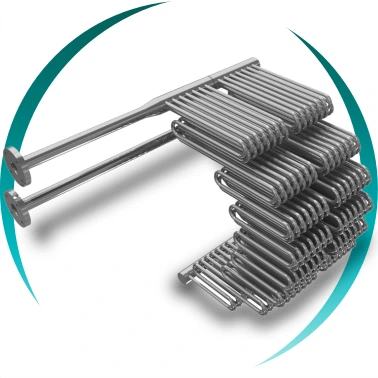
Tubular coils for saturated, wet, superheated and flash steam. Controlled condensation up to 950°C. Primary energy carrier.
View solutions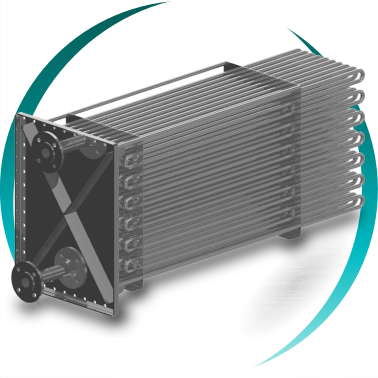
Bare tube coils for viscous fluids, sediments and strict sanitation requirements. Easy mechanical cleaning or CIP.
View solutions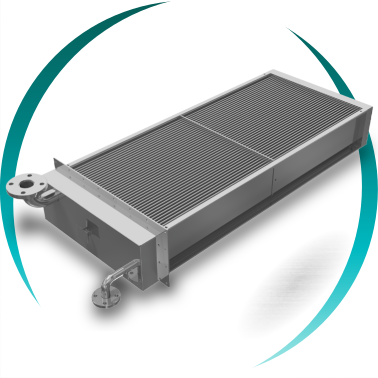
Aerodynamic profile coils for applications with external gas and very limited space. Minimal pressure drop on the gas side.
View solutions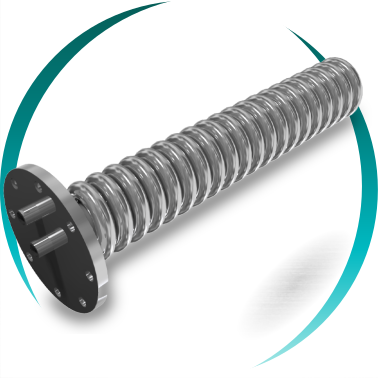
Continuous helical coils with no welded joints for high pressure, intense thermal cycles and critical applications. Insertable cartridge format.
View solutionsCritical design factors for heat exchanger coils
- Nature and properties of the internal fluid: viscosity, vapour pressure, corrosivity
- Maximum working temperature and thermal gradients in transient conditions
- Service pressure and applicable standards (PED, ASME, ATEX)
- Geometry of the receiving space: diameter, height and accessibility for assembly
- Admissible fouling level and cleaning frequency
- Mechanical requirements: vibrations, load cycles, fatigue
Service pressure: the determining factor in construction
In heat exchanger coils, the internal working pressure directly determines the wall thickness, material and construction of the coil. Unlike an external industrial heat exchanger with a shell, the integrated coil has no external containment: all pressure resistance depends on the tube and its joints.
Coils operating above 0.5 bar with Group 1 (hazardous) fluids or above PED thresholds are subject to Directive 2014/68/EU, with categorisation based on the fluid, pressure and nominal diameter. At BOIXAC we specify the applicable PED category during the technical specification phase, before beginning constructive design.
Seamless construction in the primary circuit represents the highest reliability solution for applications where the absence of failure points is a non-negotiable requirement: aerospace, high-criticality chemical processes, nuclear applications and high-pressure boilers.
Frequently asked questions about industrial heat exchanger coils
What is the difference between a heat exchanger coil and a finned heat exchanger?
The coil focuses on the tube bundle, while the finned heat exchanger incorporates fins to improve efficiency.
The fundamental difference is the fins. A finned heat exchanger combines tubes and fins to increase the contact surface, typically for the process gas. A heat exchanger coil focuses on the tubes, and is particularly suitable for applications with thermal fluids of similar characteristics. Coils are often integrated within existing equipment — tank, reactor, boiler, chamber — with the equipment itself acting as the container for the external fluid. This integration eliminates the cost of external equipment and its piping, reduces space requirements and simplifies the plant layout.
When is a heat exchanger coil preferable to an external unit?
When space is limited or the process already contains the fluid, avoiding complex external installations.
When space is limited, the external fluid is already contained in process equipment, or when installing an external unit would require pipe connections or plant shutdowns that cannot be accommodated. Coils are particularly suitable for boilers, reactors, thermal storage tanks and treatment chambers where heat exchange is an integrated process function, not a separate stage.
What fluids can circulate inside the coil?
Virtually any industrial fluid, depending on compatibility with the tube material.
Virtually any industrial fluid: saturated steam, wet steam, superheated steam, hot water, superheated water, thermal oil, diathermic fluids, refrigerants, process gases and chemical fluids compatible with the tube material. Material selection — carbon steel, AISI 304/316L, Hastelloy, titanium, duplex — determines compatibility with corrosive or aggressive fluids.
Can heat exchanger coils operate submerged in liquids?
Yes, they work submerged, exchanging heat directly without external circuits or additional pumps.
Yes. It is one of their most common applications. The coil submerged in a tank or reactor directly transfers heat to the contained liquid, without additional pumps or external circuits. This configuration is particularly efficient for viscous or sediment-laden fluids, as the coil geometry maintains contact surface even with non-homogeneous fluids.
What materials are typically used in heat exchanger coils?
They depend on the fluid and conditions: carbon steel, stainless grades, special alloys or corrosion-resistant materials.
Selection depends on the fluid, temperature and pressure. For non-corrosive fluids and moderate temperatures, carbon steel is used. AISI 304 and 316L are common in food, pharmaceutical and processes with moderately corrosive fluids. For temperatures above 400°C, AISI 309 or 310 steels may be required. In the presence of aggressive or halogenated fluids, Hastelloy C-276, titanium or duplex is used. Correct material selection is the factor that most determines coil service life.
What is the maximum temperature and pressure a heat exchanger coil can withstand?
Up to 950°C and 100 bar depending on material and design; subject to PED regulation.
BOIXAC coils can operate up to 950°C in the internal fluid with appropriate materials — refractory steels AISI 309/310, Incoloy, nickel alloys — and up to 100 bar of pressure depending on the tube diameter and wall thickness. For applications above PED thresholds, categorisation under Directive 2014/68/EU is mandatory, and BOIXAC manages this during the technical specification phase.
Is it possible to design a coil for a space with irregular geometry?
Yes, they adapt to irregular geometries optimising space and thermal performance.
Yes. Geometric flexibility is precisely the main advantage of the coil over other heat exchangers. BOIXAC adapts the configuration — helical, flat, U-shape, zigzag or special forms — to the exact dimensions of the receiving equipment, optimising the exchange surface within the available volume without compromising thermal performance or mechanical safety.
What standards apply to industrial heat exchanger coils?
Primarily PED 2014/68/EU; also ATEX or FDA depending on the application.
Coils operating above the pressure and temperature thresholds defined in the Pressure Equipment Directive 2014/68/EU (PED) must be categorised and subjected to the corresponding conformity assessment procedures. In installations with potentially explosive atmospheres, ATEX Directive 2014/34/EU additionally applies. For food and pharmaceutical industries, FDA standards may additionally apply depending on the market. BOIXAC determines applicable standards during the design phase.
What is the difference between smooth tube, flat tube and seamless coils?
Smooth: easy cleaning; flat: low pressure drop; seamless: high pressure and maximum reliability.
Each type responds to a different process context and they are not interchangeable. The smooth tube coil is optimised for viscous or sediment-laden fluids where hygiene and ease of cleaning are priorities. The flat tube coil is designed for applications where the external gas must pass through the coil with minimal pressure drop, thanks to its aerodynamic profile. The seamless coil is designed for high pressure and maximum structural reliability, eliminating critical stress points. The correct choice depends on a joint analysis of the fluid, the external medium and the mechanical requirements of the process.
Projects with heat exchanger coils executed by BOIXAC
BOIXAC has conceived and supplied heat exchanger coils in high-demand European industrial installations, including:
- Steam coils for heavy oil heating systems in industrial waste treatment plants, with working pressures above 40 bar
- Smooth tube coils for heating and cooling viscous products in the food and biofuels industry, with certified CIP cleaning requirements
- Seamless coils for integration in heat recovery boilers at cogeneration plants, with fluid temperatures above 400°C
- Flat tube coils for heat recovery in industrial drying chambers with severe space constraints and a maximum pressure drop of 15 Pa
These projects are always developed from specific thermal calculations, validated material selection and regulatory compliance verification when applicable.
Do you need a heat exchanger coil integrated in your process
Our technical team analyses the geometry of your installation, the working fluid, the pressure and temperature conditions and the applicable standards, and proposes the most suitable coil design: steam, smooth tube, flat tube or seamless.
We work with plant engineers, process managers and OEM equipment manufacturers across Europe.