
Gas-to-gas heat exchanger
A gas-to-gas heat exchanger is an industrial device that transfers thermal energy between two independent gas streams — air, flue gases, process gases, industrial fumes or other gases — through a solid separation surface, without fluid mixing or direct contact between streams. It typically operates between 100°C and 1,200°C and is used primarily to recover residual heat from hot gases and transfer it to a second gas stream, reducing fuel consumption, improving process efficiency and lowering CO₂ emissions from the installation.
Gas-to-gas energy recovery with BOIXAC industrial engineering
At BOIXAC, we conceive and optimise custom industrial gas-to-gas heat exchangers, focused on recovering waste heat, improving energy efficiency and reducing operational costs in demanding industrial processes.
Our solutions enable the recovery of heat contained in hot gases — air, flue gases, nitrogen or other process gases — and its controlled transfer to a second independent gas stream. In this way, energy losses are transformed into reusable thermal resources, with a direct impact on process performance and the installation’s carbon footprint.
This page serves as the central node of the BOIXAC gas-to-gas cluster, providing a global and conceptual overview of the technology, and linking to specific solutions: air-to-air, air-to-flue gas and cross-flow plate recuperators, where construction and application details are fully presented.
Conceptual engineering applied to gas-to-gas heat exchangers
At BOIXAC, we do not work with standard equipment. Each gas-to-gas heat exchanger is conceptualised based on a thorough technical analysis of the process, aiming to define the technology that maximises return on investment (ROI) and ensures long-term reliability.
Key parameters analysed include:
- Inlet and outlet temperatures of the gas streams
- Mass and volumetric flow rates
- Chemical composition and presence of contaminants
- Allowable fouling levels
- Maximum allowable pressure drops
- Thermal expansion and mechanical stress conditions
- Sealing requirements between streams
- Cleaning and maintenance needs
This approach allows precise selection of the optimal gas-to-gas technology, avoiding oversizing, operational problems or performance loss over time.
Among the most demanding applications BOIXAC has solved are recuperative thermal oxidisers (RTO), where the gas-to-gas heat exchanger is the core of the system: it preheats the contaminated gases before the oxidation chamber, drastically reducing auxiliary gas consumption and improving the destruction of volatile organic compounds (VOC) and other atmospheric pollutants.
How a gas-to-gas heat exchanger works
The operation of a gas-to-gas heat exchanger is based on three fundamental steps:
- The hot gas stream transfers its thermal energy to the separation surface.
- Heat is conducted through the exchanger material.
- The cold gas stream absorbs this energy by convection, increasing its temperature.
At no point do the gases come into direct contact, ensuring functional separation of the streams and process safety.
Typical technical parameters of gas-to-gas heat exchangers
The following table shows the typical technical ranges of industrial gas-to-gas heat exchangers. Exact values depend on the gas type, fouling level and specific process requirements.
| Parameter | Typical range | Determining factors |
|---|---|---|
| Hot gas temperature | 100 – 1,200°C | Exchanger material, gas type |
| Cold gas temperature (outlet) | 50 – 800°C | Available ΔT, heat transfer area |
| Operating pressure | Low – medium pressure | Typically <5 bar for process gases |
| Typical thermal efficiency | 60 – 85% | Flow configuration, surface area, ΔT |
| Fuel consumption reduction | 10 – 30% | Inlet gas temperature, flow rates |
| Typical material up to 400°C | AISI 304 / AISI 316L | Non-corrosive gases, sulphur-free |
| Typical material 400 – 900°C | AISI 309 / AISI 310 | High temperature, oxidising atmosphere |
| Material for sulphur-bearing flue gas | AISI 316L / Ni alloys | Acid condensation risk (H₂SO₄) |
Indicative values. Exact sizing requires gas composition analysis, temperature curves and acid dew point assessment. Contact our technical team for your specific application.
Direct benefits for energy efficiency
Integrating a gas-to-gas heat exchanger produces direct, measurable and quantifiable impacts:
- Reduced energy consumption through reuse of residual heat
- Preheating or precooling of gases entering reactors, furnaces or process chambers
- Decreased CO₂ and greenhouse gas emissions
- Lower operational costs, with typical ROI between 3 and 12 months depending on the application
Industrial applications of gas-to-gas heat exchangers
Combustion air preheating
Typical application of air-to-flue gas heat exchangers. Exhaust gases from furnaces, boilers or turbines (200–600°C) transfer energy to the incoming combustion air, improving flame efficiency and reducing fuel consumption by approximately 10–30%.
Industrial ventilation and HVAC
Using air-to-air heat exchangers, hot extracted air transfers energy to incoming outside air, reducing heating or cooling demand in industrial buildings and manufacturing facilities.
Chemical and pharmaceutical processes
Control and stabilisation of process gas temperatures, recovering internal energy while ensuring thermal homogeneity and reaction stability throughout the production cycle.
Gas effluent treatment
Pre-cooling of gases before filters, scrubbers or purifiers, protecting critical downstream equipment and recovering energy for other process stages.
Industrial drying
Recovery of exhaust air heat to preheat fresh incoming air, reducing the overall energy consumption of industrial drying systems.
Recuperative thermal oxidisers (RTO)
The gas-to-gas heat exchanger is the core component that makes the RTO process viable: it preheats the contaminated gases using the heat already recovered from treated gases, achieving VOC destruction above 99% with minimal auxiliary gas consumption.
Which gas-to-gas heat exchanger do I need for my process?
The choice between available gas-to-gas technologies depends primarily on the required sealing level, the presence of fouling and the operating temperatures. The following table provides an initial selection guide:
| Technology | Sealing | Fouling | Max. temp. | Footprint | Typical application |
|---|---|---|---|---|---|
| Air-to-air heat exchanger | ~99% | High tolerance | ~900°C | Compact–medium | Furnaces, industrial buildings, dust |
| Air-to-flue gas heat exchanger | 100% | Moderate tolerance | ~1,000°C | Medium–large | Combustion gases, RTO, fumes |
| Cross-flow recuperator | High | Clean gases only | ~600°C | Very compact | Industrial HVAC, clean gases |
Final selection requires specific process analysis. BOIXAC defines the optimal technology based on detailed operating parameter assessment.
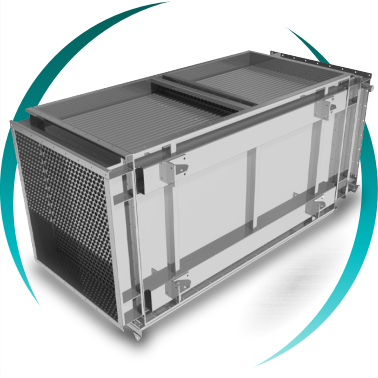
Expanded tubes against terminal plates with no welds. High fouling tolerance and excellent performance at very high temperatures.
View solutions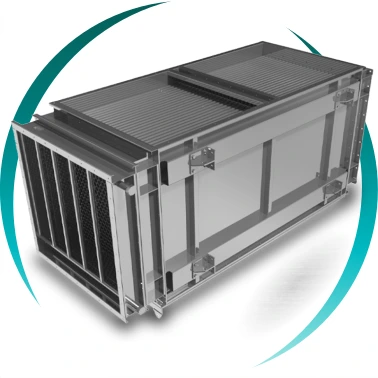
Welded tubes on terminal plates with 100% sealing between streams. Designed for combustion gases and industrial flue gas applications.
View solutions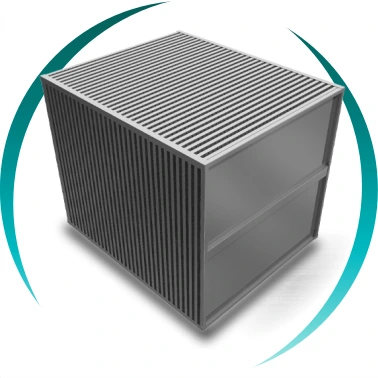
Compact plate-based technology for clean gases. High thermal efficiency in a reduced footprint, modular design and easy system integration.
View solutionsCritical design and selection factors
Temperature difference (ΔT)
Mass and volumetric flow rates
Allowable pressure drop
Chemical composition and acid dew point
Cleaning and maintenance strategy
Available space and installation criteria
Acid dew point: the most underestimated critical factor
In gas-to-gas heat exchangers handling sulphur-bearing combustion gases (fuel oil, coal, wet biomass), the condensation of sulphuric acid (H₂SO₄) or hydrochloric acid (HCl) on the heat transfer surfaces can destroy the equipment within weeks if not correctly accounted for in the design.
The acid dew point of SO₂ in the presence of moisture typically falls between 120°C and 160°C. Designing the heat exchanger with wall temperatures below this threshold, without appropriate protective measures, is the most common error in the specification of flue gas heat recovery units.
At BOIXAC, we calculate the acid dew point during the conceptual design phase and select the appropriate material and geometry to ensure the long-term integrity of the equipment.
Frequently asked questions about gas-to-gas heat exchangers
Which material is best suited for an air-to-flue gas heat exchanger?
It depends on the operating temperature, flue gas composition and the risk of corrosion or acid condensation. For natural gas or diesel flue gases with low sulphur content at temperatures up to 400–500°C, AISI 316L is usually suitable provided acid condensation is avoided. At higher temperatures or in strongly oxidising environments, high-temperature alloys such as AISI 309 or AISI 310 are typically used. At BOIXAC, the final material selection is based on a specific corrosion and condensation analysis.
Are gas-to-gas heat exchangers easy to clean?
Yes, if cleaning is considered from the conceptual design phase. The cleaning strategy is defined through access ports, smooth tubes, wide passages and, if necessary, automatic cleaning systems. In critical applications, modular designs facilitate preventive and corrective maintenance.
What energy savings can I expect from a gas-to-gas heat exchanger?
Typically between 10% and 30% reduction in fuel consumption. Savings depend on the temperature differential (ΔT), mass flow rates and annual operating hours. In industrial ventilation systems with heat recovery, energy demand reduction can reach 40–70%. Exact calculation requires a specific energy assessment of the process.
What is the service life of an industrial gas-to-gas heat exchanger?
Very long with proper design and maintenance. Service life depends primarily on corrosion, erosion and accumulated fouling. Correct material selection based on the gas composition, combined with a preventive maintenance programme, allows stable thermal performance to be maintained for 15–25 years in most industrial applications.
Which is more efficient: air-to-air or air-to-flue gas?
Both can achieve efficiencies above 70–80%. The choice does not depend on efficiency alone, but on the required sealing between streams, fouling level, corrosion risk, thermal expansion and maintenance requirements. At BOIXAC, we define the optimal technology on a case-by-case basis, based on detailed process analysis.
What is the acid dew point and why does it affect the heat exchanger?
The acid dew point is the temperature below which sulphuric or hydrochloric acid vapours present in combustion gases condense on the metallic surfaces of the heat exchanger. In flue gases with sulphur content, this point typically falls between 120°C and 160°C. If the wall temperature of the exchanger drops below this threshold, acid condensation causes severe corrosion that can destroy the equipment within weeks. The design must maintain wall temperatures above this critical threshold.
What is the difference between a heat recuperator and a regenerator?
A heat recuperator transfers energy between two streams through a fixed solid separation surface, continuously and simultaneously: both gases flow at the same time on opposite sides of the wall. A regenerator, by contrast, uses a solid storage medium (ceramic, metallic) that absorbs heat from one stream and then releases it to the other in alternating cycles. BOIXAC heat exchangers are recuperators. The most compact RTO systems combine both principles.
Is compliance with the PED Directive required for gas-to-gas heat exchangers?
It depends on the operating conditions. Most industrial gas-to-gas heat exchangers operate at low pressure and may fall outside the scope of the Pressure Equipment Directive 2014/68/EU (PED), classified under Article 4.3 or Category I. However, when pressures are higher or fluids are classified as hazardous, higher categories apply with greater documentation and inspection requirements. At BOIXAC, we determine the applicable PED category during the technical specification phase.
How long does it take to achieve payback on a gas-to-gas heat exchanger?
The return on investment (payback) period typically ranges from 6 months to 3 years, depending on energy costs, annual operating hours and available temperature differential. In applications with natural gas at 0.05–0.08 €/kWh and continuous operation, the shortest paybacks are achieved in combustion air preheaters with exhaust gases above 300°C. BOIXAC can provide a preliminary ROI estimate based on basic process data.
Can a gas-to-gas heat exchanger handle corrosive or dirty gases?
Yes, with the appropriate design. Gases containing dust, particles, soot or corrosive components require specific geometries: wide tube spacing, smooth tubes instead of finned ones, access points for mechanical cleaning or air purging, and materials selected based on the gas corrosion analysis. For gases with acidic components or abrasive particles, BOIXAC always recommends a prior analysis of gas composition before defining the exchanger geometry and material.
Gas-to-gas projects delivered by BOIXAC
BOIXAC has concevied and supplied gas-to-gas heat exchangers in demanding European industrial environments, including:
- Heat recovery units for recuperative thermal oxidisers (RTO) at a bioplastics plant in the Netherlands, with process gases at temperatures above 800°C
- Gas-to-gas heat exchangers for combustion air preheating at mineral processing plants, achieving over 20% reduction in gas consumption
- Heat recovery systems in VOC treatment installations at metallurgical facilities, with destruction efficiencies above 99%
- Exhaust gas recuperators for industrial drying applications at biogas plants, optimising the overall energy balance of the process
These projects are always developed from a prior technical analysis of the process, with specific material selection and acid dew point validation where applicable.
Do you have a process with hot gases to recover?
Our technical team analyses your process conditions — temperature, flow rate, gas composition, fouling level and applicable standards — and proposes the most suitable gas-to-gas heat exchanger solution, whether air-to-air, air-to-flue gas or cross-flow recuperator.
We work with process engineers, energy managers and EPC contractors across Europe.