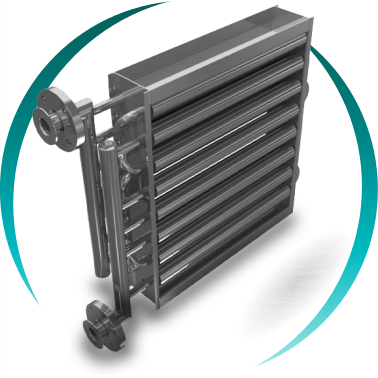
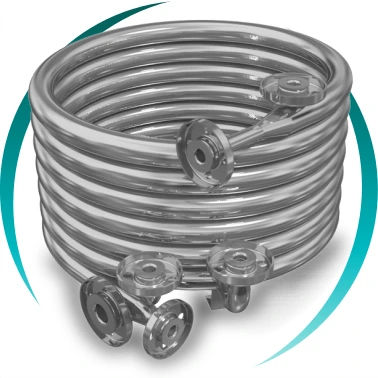
Heat exchanger coil for industrial thermal exchange
At BOIXAC, we design industrial heat exchange solutions using custom-engineered tube coils, aimed at process cooling, energy recovery, and controlled thermal treatment of gases, liquids, and bulk solids in demanding industrial environments.
Tube coils are not a standard product, but an engineering solution integrated into the process. Each design is tailored to a specific combination of fluid, thermal regime, available space, mechanical conditions, and maintenance requirements, ensuring efficiency, reliability, and optimal service life.
Thermal architecture of tube coils
Tube coils constitute a highly versatile heat exchange architecture, capable of adapting to:
Fluids with very different thermodynamic properties
High temperatures and thermal gradients
Corrosive or abrasive environments
Geometrically constrained spaces
Direct integration into existing process equipment
Unlike standalone standard heat exchangers, a tube coil is usually designed as a functional element integrated within reactors, gas ducts, treatment chambers, tanks, or special heating/cooling systems.
At BOIXAC, the design always starts from the limiting fluid and the actual process, not from a closed typology.
What are tube coils?
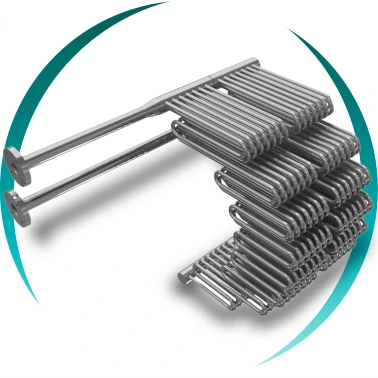
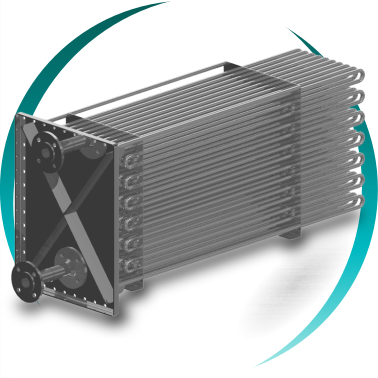
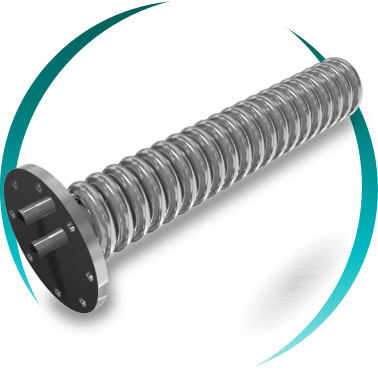
Tube coils are heat exchange systems made of tubes arranged in serpentine, coil, or special geometries, optimized to maximize the exchange surface within a given volume, while controlling pressure drop and mechanical behavior.
Their main strength is the ability to adapt to the process, in both steady-state and transient regimes, working with liquids, gases, vapors, or complex fluids.
Types of tube coils we design
The following types are not interchangeable solutions, but technical responses to specific fluids and operating conditions.
Steam heat exchanger
Tube coils specifically engineered for thermal transfer via steam, ensuring controlled, efficient, and stable condensation.
Main features
Design for high temperatures (up to 950°C)
Optimized condensate drainage and thermal shock control
Typical applications
Liquid–liquid exchange
Steam condensation
Heating and cooling of process fluids
Smooth tube heat exchanger
Smooth tube coils designed for processes with high cleaning, hygiene, and maintenance requirements, with minimal flow resistance.
Main features
Simple and accessible geometry
Easy mechanical cleaning or CIP (Clean-In-Place)
Direct integration into tanks and vessels
Typical applications
Process fluid cooling
Food, chemical, and pharmaceutical industries
Flat tube heat exchanger
Flat tube coils designed to maximize exchange surface in very limited spaces, with special attention to pressure drop.
Main features
Reduced aerodynamic resistance (lower fan consumption)
Improved overall heat transfer coefficient
Typical applications
Space-constrained processes
Chemical, pharmaceutical, and Oil & Gas industries
Weldless heat exchanger
Industrial tube coils without welds on the primary circuit, designed for mechanically challenging environments.
Main features
No critical fatigue or corrosion points
High resistance to vibrations and thermal cycles
Demountable design for inspection and maintenance
Typical applications
Boilers
Evaporators and condensers
Critical process equipment
Finned tube heat exchanger
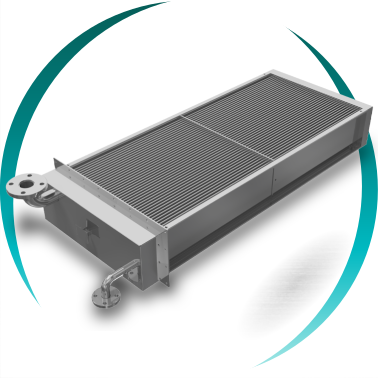
Finned tube coils with helical or continuous fins, especially indicated when the limiting fluid is a gas.
Main features
Significant increase in heat transfer surface
Optimized according to fouling and pressure drop
Ideal for fluids with low heat transfer coefficient
Typical applications
Process cooling and heating
Energy recovery
Food, pharmaceutical, chemical, paper, and Oil & Gas industries
Liquid tube heat exchanger
Thermodynamic solutions to transfer heat between two liquids, which may be viscous, sticky, or even contain sediments.
Main features
Handles viscous, dirty, or sediment-laden fluids
Demountable or fixed designs depending on maintenance requirements
Process cooling, energy recovery, and controlled thermal treatment.
BOIXAC tube coils are used for cooling thermal oils, process fluids, steam condensation, waste heat recovery, and gas cooling, as well as in special applications fully integrated into the process.
When is it recommended to use finned tube coils?
When the limiting fluid is a gas.
Fins allow increasing the effective heat transfer surface when the heat transfer coefficient is low. Geometry is defined according to fouling, flow regime, and permissible pressure drop.
What are the advantages of weldless tube coils?
Mechanical reliability and extreme durability.
The absence of welds eliminates critical fatigue and corrosion points, increasing service life in high-pressure, vibration, or aggressive fluid applications.
How is the appropriate material for a tube coil selected?
According to fluid, temperature, and lifecycle.
We evaluate chemical compatibility, pressure, temperature, maintenance, and overall cost, ensuring the best balance between performance and durability.
What are the key factors in designing a tube coil?
Process, fluid, space, and maintenance.
We analyze temperatures, flow rates, fluid properties, pass configuration, and accessibility, resulting in a stable, efficient, and fully integrated solution.