
Solid-liquid heat exchanger for industrial processes
A solid–liquid heat exchanger is an industrial piece of equipment designed to transfer thermal energy between a fluid (water, glycol, refrigerant or steam) and a product containing solids, particles, fibres or heterogeneous phases, ensuring efficient, safe and stable thermal control of the process.
What is a solid–liquid heat exchanger?
This type of heat exchanger is essential when:
the product is not fully liquid
there is a risk of fouling or clogging
high hygiene standards are required
cooling, refrigeration or heating with high industrial reliability is needed
A solid–liquid heat exchanger allows products containing solids to be cooled or heated without loss of efficiency or process safety
Why are solid–liquid heat exchangers critical in industry?
In demanding industrial sectors, conventional liquid–liquid heat exchangers are not sufficient. Solid–liquid heat exchangers make it possible to:
Maintain product quality
Prevent blockages and unplanned shutdowns
Improve real thermal transfer
Optimise energy consumption
Facilitate CIP/SIP cleaning
At BOIXAC, we provide specific solutions for processes involving solids, integrating applied thermal engineering, suitable materials and optimised geometries.
Solid–liquid heat exchange technologies
Pillow plate heat exchanger (dimple plate)
Pillow plate or dimple plate technology is based on inflated metal plates that generate internal turbulence, increasing the heat transfer coefficient and reducing dead zones.
It is particularly suitable for:
products containing solids or fibres
hygienic and sanitary applications
industrial refrigeration
ice accumulation and storage
This technology forms the core axis of the cluster, with specific models developed by BOIXAC in collaboration with its partners.
Immersion heat exchanger
Immersion heat exchangers allow direct contact with the product inside the tank or reactor and are commonly used in:
fermentation
beer
wine
batch processes in food and beverage production
Jacketed tanks (cooling jackets)
Refrigerated jackets provide homogeneous temperature control in processes with high thermal demand, such as:
chemical reactions
controlled fermentations
viscous products containing solids
Accumulator and ice bank
Advanced systems for:
rapid cooling of process water
cold storage
reduction of peak energy demand
refrigerated transport and industrial logistics
Key benefits of BOIXAC solid–liquid heat exchangers
High real heat transfer efficiency
Reliable operation with products containing solids
Robust, industrial-grade design
Reduced fouling and maintenance requirements
Integration with existing refrigeration systems
Process energy optimisation
Fully customised solutions
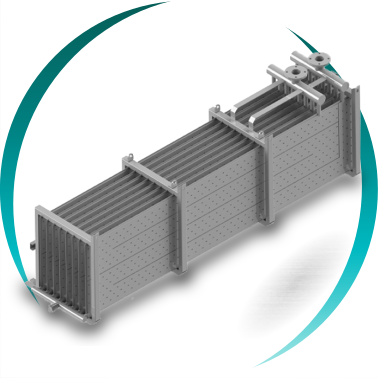
Main industrial applications
BOIXAC solid–liquid heat exchangers are used in:
Food industry: dairy products, fruit, nuts, vegetables, pasta, fish and seafood, coffee (green beans), cereals (rice, wheat, barley, etc.), seeds, cocoa, etc.
Beverages: beer, wine, alcoholic and non-alcoholic fermentation
Industrial chemistry: suspensions, controlled reactions
Biomass and energy: heat recovery and energy recovery
Industrial refrigeration and refrigerated transport
Bulk solids with thermal control requirements
Industrial engineering, design and manufacturing
BOIXAC develops solid–liquid heat exchangers based on:
thermal analysis of the process
in-depth product knowledge
sanitary and regulatory requirements
energy efficiency objectives
Each solution is designed, manufactured and validated to guarantee performance, durability and industrial safety.
Heat exchanger
for bulk solids
The alternative
to fluidized beds
FAQs
What is the difference between a solid–liquid and a liquid–liquid heat exchanger?
A solid–liquid heat exchanger operates with products containing particles.
It is designed to prevent clogging and maintain stable heat transfer with solids in suspension.
Is pillow plate technology suitable for food applications?
Yes, it is ideal.
Its hygienic design and controlled turbulence make it highly suitable for foods containing solids.
Can they be used in fermentation processes?
Yes.
They allow precise temperature control without affecting the product or the biological process.
Are they suitable for ice accumulation and storage?
Yes.
When integrated into ice bank systems, they help optimise energy consumption.
What maintenance do they require?
Low.
The design minimises fouling and facilitates CIP/SIP cleaning.
Can they recover waste heat?
Yes.
They are ideal for energy recovery in continuous industrial processes.
Are they standard or custom-made solutions?
Custom-made.
Each unit is designed according to the product, flow rates and process temperatures.
In which sectors are they most commonly used?
Food, beverages, chemical and energy industries.
Especially in processes involving solids, high viscosity or strict sanitary requirements.