A heat exchanger for the glass industry is equipment designed to recover, transfer, and control thermal energy in melting furnaces, annealing furnaces, and combustion systems, with the aim of reducing energy consumption, stabilizing the process, and improving the quality of the final product.
It typically operates with:
High-temperature exhaust gases
Combustion air
Steam and superheated water
Thermal fluids
Cooling air streams
In the glass sector, thermal management is the determining factor between energy efficiency and quality deviations.
High-temperature thermal solutions for furnaces up to 1600 °C
Glass manufacturing begins with the melting of:
Silica sand
Sodium carbonate
Calcium oxide
In furnaces that can reach temperatures close to 1600 °C, generating a molten glass mass that is later shaped through:
Mold blowing
Float process over a molten tin bath
Rolling with rollers
Molding for containers and technical parts
This environment involves:
Continuous 24/7 cycles
Intensive combustion
High volumes of hot gases
High energy demand
Heat recovery and optimization are not optional: they are strategic.
The glass industry: thermal demand and energy consumption
The glass sector is one of the most energy-intensive industries within heavy industry. The main critical points are:
Melting furnaces
Annealing furnaces
Burners
Flue gas extraction systems
Controlled cooling after forming
Without proper integration of heat exchangers:
Fuel consumption increases
Burner service life is reduced
Internal stresses are generated in the glass
Optical or structural quality deteriorates
Key applications of heat exchangers in the glass sector
Exhaust gas heat recovery
Gases coming from the melting furnace contain a large amount of residual energy.
Through heat recovery systems:
Gases are cooled before discharge
Combustion air is preheated
Fuel consumption is reduced
Emissions are decreased
This process can significantly improve the overall efficiency of the system.
Combustion air preheating
Fresh air for burners can be heated using:
Cross-flow heat exchangers
Tubular recuperators
Result:
Greater flame stability
Improved furnace efficiency
Reduced energy costs
Cooling and annealing control
After forming, glass requires homogeneous and controlled cooling to avoid:
Internal stresses
Microfractures
Deformations
Heat exchangers contribute to:
Regulating cooling air flows
Homogenizing the thermal process
Improving the final product quality
Global energy integration
Recovered heat can be used for:
Auxiliary systems
Steam generation
Fluid preheating
Improvement of internal processes
This transforms residual energy into productive value.
Types of heat exchangers for the glass industry
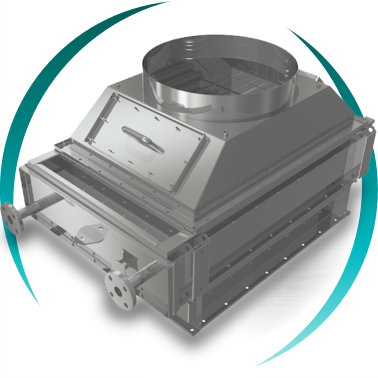
Steel heat recovery unit for exhaust gases
High thermal resistance
Design with inspection openings
Optimized cleaning and maintenance systems
Possibility of integrating air diffusion systems
Application: melting furnaces and intensive combustion systems.
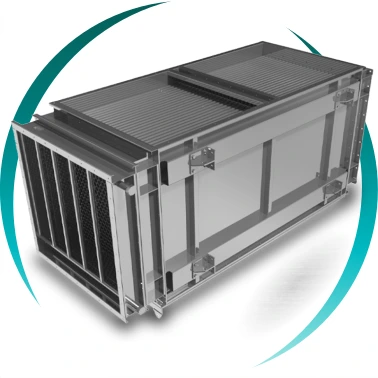
Cross-flow heat exchanger
Heat transfer between extraction gas and combustion air
Physically separated flows
Optimized pressure drop
Robust design for environments with particles
Ideal for preheating air before entering the furnace.
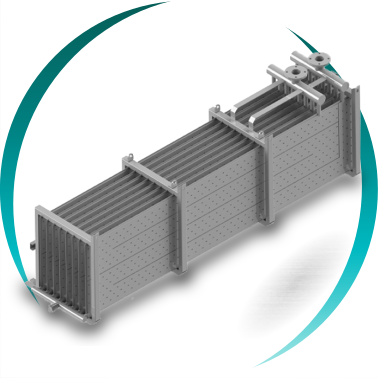
Pillow plate heat exchanger
Characteristics:
Large heat transfer surface
Configuration for process cooling
Option with pillow technology to improve homogeneity
Application: controlled cooling processes
Engineering for high-demand environments
Equipment intended for the glass industry requires:
Precise thermal calculations
Selection of materials resistant to high temperatures
Analysis of thermal expansion
Resistance to thermal shock
Design facilitating inspection and maintenance
It is common to include:
Material certificates
Qualified welding procedures
Non-destructive testing
Quality documentation dossiers
This approach reinforces reliability and industrial traceability.
Tailor-made solutions designed for glass production.
We detail quotations with precision and rigor.
Products subjected to strict quality control.
Fast and on-time response to minimize impact on the plant.
FAQs
Why are heat exchangers essential in the glass industry?
To reduce energy consumption and stabilize the melting and annealing processes.
Glass manufacturing is highly energy intensive. Recovering heat from exhaust gases and controlling cooling thermally allows improved performance, quality, and process sustainability.
What temperature can these units withstand?
They can be designed to operate with gases from furnaces reaching up to 950 °C.
Design and materials are adapted to the specific environment. In melting applications, high-temperature gases and continuous cycles require high thermal and mechanical resistance.
How do they contribute to sustainability?
By recovering residual energy and reducing fuel consumption.
By preheating combustion air and reusing heat from gases, energy consumption and associated emissions are reduced, improving the plant’s overall efficiency.
What impact do they have on glass quality?
They enable controlled and homogeneous cooling.
Proper thermal control prevents internal stresses and structural defects, ensuring better mechanical strength and optical quality.
Heat exchangers for the glass industry
Solutions adapted to:
Melting furnaces
Annealing furnaces
Combustion systems
Gas recovery
Controlled cooling
Thermal engineering for efficient, sustainable, and stable glass processes.
In a sector where energy is the main operating cost, heat recovery and control make the competitive difference.