Industrial heat exchangers are a critical strategic asset for the ceramic industry. They enable the recovery of residual heat from kilns and dryers, preheat combustion air, optimize drying and cooling processes, and maximize overall plant energy efficiency.
Heat recovery, energy efficiency, and industrial thermal stability
In ceramic environments, heat exchangers are essential for maximizing efficiency and ensuring production stability. High-tech thermal transfer solutions allow:
Significant reduction in energy consumption and operational costs.
Recovery of residual heat for efficient reuse in production processes.
Improvement in product quality and uniformity.
Stabilization of firing and drying processes.
Ensuring compliance with industrial safety standards and regulations.
What is a heat exchanger for the ceramic industry?
A ceramic heat exchanger is equipment that transfers thermal energy between gases, air, or fluids without direct mixing, ensuring efficiency and safety. Its main functions are:
Recover residual heat from kilns and dryers.
Preheat combustion air for burners.
Supply hot air to industrial dryers.
Precisely control the cooling of parts and thermal homogenization.
Common fluids: exhaust gases, combustion air, dryer air, hot water, steam, thermal oil, or diathermic fluids.
The ceramic industry and critical thermal processes
Industrial heat exchangers stabilize temperatures in ceramic kilns and dryers, improving efficiency, safety, and product quality.
Energy-intensive and temperature-sensitive processes:
Drying of ceramic pieces: homogeneous moisture removal.
Firing in tunnel or roller kilns: continuous temperature stability.
Controlled cooling: prevention of internal stresses and micro-cracks.
Combustion gas management: energy recovery and reuse.
Key applications of heat exchangers in the ceramic sector
Kiln gas heat recovery
Controlled reduction of gas temperature before filtration.
Preheating of combustion air.
Supply of hot air to dryers.
Generation of steam or hot water for auxiliary industrial processes.
Reduction in fuel consumption and emissions.
Industrial impact: typical energy savings of 15–30 % in plants with continuous kilns.
Combustion air preheating
Improvement in burner efficiency.
Thermal stability of the kiln.
Reduction in gas or fuel consumption.
Precise and consistent control of firing.
Reduction in pollutant emissions.
Ceramic dryers
Uniform air heating.
Recovery of heat from exhaust air.
Constant temperature control.
Reduction in product defects: cracks, warping, and breakage.
Controlled cooling of parts
Regulation of cooling air flow.
Heat recovery for other processes.
Ensures thermal stability and product uniformity.
Industrial conditions and requirements
Ceramic industry heat exchangers are designed to operate at high temperatures in abrasive and dusty environments, ensuring continuity and efficiency. They must withstand:
Continuous high temperatures.
Presence of dust and abrasive particles.
Corrosive environments.
Continuous 24/7 operation.
Thermal expansions and vibrations.
Industrial cleaning and inspection requirements.
Controlled pressure drops.
High mechanical robustness.
Types of heat exchangers for the ceramic industry
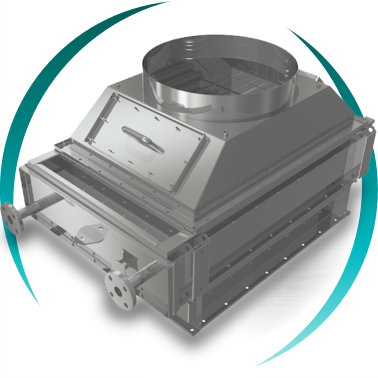
Hot gas heat recovery units
High thermal and mechanical resistance.
Designed for gases containing dust and particles.
Integrated cleaning and inspection systems.
Construction in stainless steel or carbon steel.
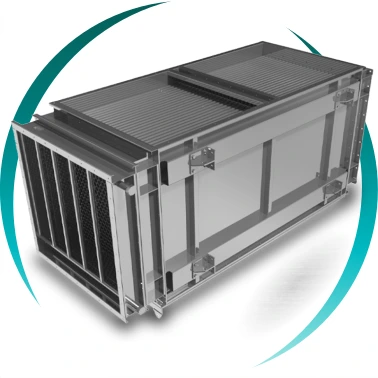
Gas-to-gas heat exchangers
Heat transfer without mixing streams.
Preheating of combustion air and dryers.
Reduction of energy consumption.
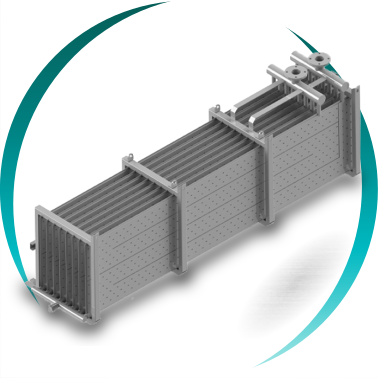
Pillow plate heat exchanger
Supply of hot air and process cooling.
High heat transfer surface area.
Modular design and easy maintenance.
Adaptable to large industrial volumes.
Industrial and strategic benefits
Heat recovery in ceramic processes can reduce energy consumption by up to 30 % and improve production quality and stability.
Reduced energy consumption and OPEX.
Recovery of residual heat.
Improved thermal efficiency of kilns.
Process stability and product uniformity.
Reduced pollutant emissions.
Fast return on investment.
Industrial sustainability and competitiveness.
Industrial design and engineering
Customized thermal calculations.
Analysis of mechanical stresses and thermal expansion.
Material selection according to temperature and corrosion.
Study of pressure drops and fouling.
Structural design and industrial maintenance.
Quality control and complete technical documentation.
Impact of inadequate design: shutdowns, premature wear, higher energy consumption, and product defects.
Custom-made solutions designed for ceramic production.
Precise and rigorous heat exchange quotations.
Products subject to strict quality control.
Rapid, on-time response to minimize plant impact.
FAQs
What are heat exchangers used for in the ceramic industry?
They recover heat from kilns and dryers, preheat air, and reduce energy consumption.
Reuse energy from exhaust gases and hot air in dryers, combustion air, or auxiliary processes, improving efficiency, stability, and industrial quality.
Where are ceramic heat exchangers installed?
At gas outlets, dryers, air ducts, and chimneys.
According to flow studies and energy balance, at tunnel or roller kiln exits, dryers, and industrial extraction systems.
What energy savings do they provide in the ceramic sector?
Significant reduction in overall energy consumption.
Depending on gas temperature, flow rates, and heat recovery, savings can reach up to 30 % in continuous processes.
Which type of heat exchanger is most commonly used in the ceramic industry?
Gas, gas-to-air, and finned tube recoverers.
Selection depends on temperature, flow rate, dust, and pressure drop.
Why is heat recovery strategic for the ceramic industry?
Reduces energy consumption and increases profitability.
Recovers residual energy, prevents losses in gases and hot air, stabilizes processes, and enhances industrial competitiveness.
BOIXAC solutions for the ceramic industry
Industrial heat exchangers maximize energy efficiency, process stability, and product quality with residual heat recovery and fast return on investment.
Key Features:
Advanced thermal engineering.
Industrial mechanical and structural calculations.
Adaptation to kilns, dryers, and cooling processes.
Integration with existing plant systems.
Advantages: energy savings, process stability, product uniformity, reduced emissions, and industrial profitability.