
Industrial economiser: operating principle, applications and selection criteria
The economiser is the component that converts the residual heat from boiler exhaust gases into a measurable reduction in fuel consumption. This guide analyses its operation, constructive types, main industrial applications and the technical parameters that determine its selection.
In an industrial boiler, between 10% and 20% of the fuel energy burned is lost as sensible heat in the exhaust gases discharged to atmosphere. The economiser is the device that recovers this energy and transfers it to the boiler feedwater, reducing fuel consumption without modifying the main process.
1. Definition and function of the industrial economiser
An industrial economiser is a gas-liquid heat exchanger installed at the outlet of combustion gases from an industrial boiler or furnace. Its function is to transfer the residual enthalpy of these gases to the boiler feedwater, preheating it before it enters the boiler body.
The term economiser derives directly from its function: to save fuel. By preheating the feedwater, the energy the boiler must supply to reach the vaporisation or working temperature is reduced, translating directly into lower natural gas, diesel or biomass consumption.
2. Operating principle in an industrial boiler
2.1 Energy flow and positioning
In a conventional industrial boiler, gases leave the boiler at temperatures typically between 200 °C and 450 °C. The economiser is installed precisely at this point — at the boiler gas outlet and before the stack — to extract residual enthalpy from these gases and transfer it to the feedwater.
The gas temperature at economiser outlet cannot be reduced indefinitely. In sulphur-containing fuels (diesel, heavy fuel oil, some industrial gases), the minimum temperature is set by the acid dew point temperature (typically 120–150 °C), below which condensed sulphurous acid attacks the metal surfaces of the economiser. For clean natural gas, this limit falls to approximately 55–65 °C.
2.2 Heated fluids: water, steam and thermal oil
Although the classic function of the economiser is feedwater preheating, in industrial environments the recovered heat can be transferred to other process fluids:
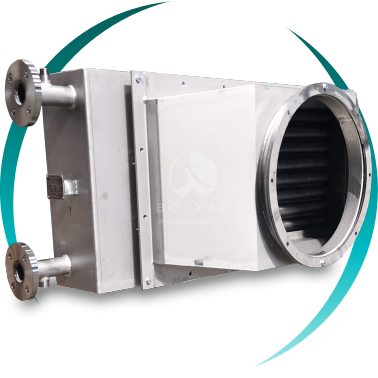
3. Constructive types of economisers
The internal construction of the economiser determines its behaviour against combustion gases and its suitability for each application.
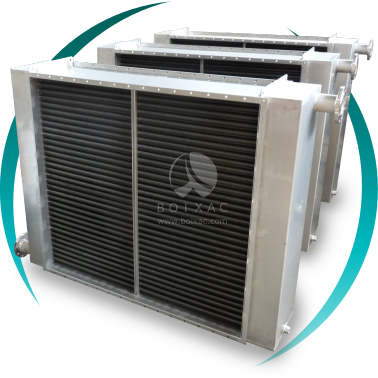
Each tube carries a sheet metal fin wound helically. The helical geometry provides greater mechanical robustness and resistance to vibrations induced by combustion gas pulsations. The pitch between turns can be adjusted to accommodate particle-laden gases (fly ash, soot).
Preferred application: natural gas, diesel, heavy fuel oil, biomass and industrial waste boilers. Environments with suspended particles in the gases.
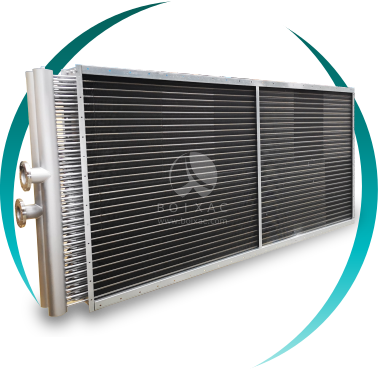
Flat perforated sheets through which tubes pass perpendicularly. Allow a higher surface density per unit volume, resulting in more compact equipment for the same recovery duty. Require gases without significant particle content to prevent inter-fin blockage.
Preferred application: natural gas boilers in clean environments or with prior gas filtration. Installations where dimensional constraints are critical.
4. Quantified energy and economic benefits
Installing a correctly sized economiser in an industrial boiler produces measurable and verifiable improvements in the overall performance of the installation.
The standard industry rule of thumb states that for every 6 °C rise in feedwater temperature, boiler fuel consumption decreases by approximately 1%. An economiser that raises the temperature by 60 °C can represent savings of 8–10% of fuel costs.
Lower fuel consumption translates directly into fewer CO₂ and NOₓ emissions per unit of useful energy produced. In facilities subject to emissions trading (EU ETS), the economiser is one of the interventions with the best investment ratio per tonne of CO₂ saved.
Preheated feedwater reduces thermal shock at the boiler inlet, decreasing temperature gradients across the shell and tubes. Contributes to extending boiler service life and reducing preventive maintenance frequency.
In continuously operated industrial boiler installations (>4,000 h/year), return on investment is typically achieved within 12 to 36 months, depending on fuel price, boiler output and the recoverable temperature differential.
5. Main industrial applications
The industrial economiser finds application in any process where a boiler or furnace generates residual combustion gases at a temperature sufficient to make heat recovery economically viable.
6. Selection and design parameters
Selecting an economiser for a specific application requires the joint analysis of a set of thermal and process parameters.
- Exhaust gas temperature and flow rate: determine available thermal power and, together with the acid dew point, the maximum achievable recovery range.
- Gas composition: presence of sulphur (acid dew point), suspended particulates (fin pitch), chlorine or corrosive compounds (material selection).
- Fluid to preheat and working pressure: high-pressure feedwater requires thicker tube walls and PED certification (Directive 2014/68/EU).
- Minimum water inlet temperature: very low water temperatures can cause gas condensation on economiser surfaces, accelerating corrosion. Recirculation systems may be required.
- Dimensional constraints and pressure drop: the economiser introduces an additional pressure drop in the gas circuit. In natural draught boilers, this may require adding an induced draught (ID) fan.
- Maintenance access: in particle-laden gases, the design must provide access for soot blowing or wet cleaning without dismantling the equipment.
BOIXAC Tech SL designs and supplies economisers for industrial boilers based on the actual conditions of each installation: gas temperature and composition, fluid to preheat, working pressure and space constraints. Each economiser is calculated thermodynamically and adapted to applicable regulatory requirements, including the PED Directive where applicable.