
Fan-cooled equipment: forced industrial cooling and heating
Fan-cooled equipment is a thermal exchange system that uses forced air convection to cool or heat a process fluid without water consumption. It integrates a heat exchange battery and one or more fans into a compact unit, designed for continuous operation in demanding industrial environments.
When a process requires dissipating heat or supplying thermal energy without access to cooling water networks, or when the cost of water consumption or its treatment makes a hydraulic solution unviable, fan-cooled equipment is the appropriate technical response. It cools or heats the process fluid exclusively with ambient air, without a cooling tower, service water circuit or effluent treatment system.
This page is the central node of the BOIXAC fan-cooled equipment cluster. It provides the selection criteria between the three technologies of the family and leads to the child pages where the technical details of each are developed: the industrial chiller, the unit heater and the dry cooler.
When fan-cooled equipment is used
Fan-equipped units constitute a family of air–fluid heat exchange systems designed to optimize energy transfer between a process fluid and air through forced convection. Their architecture enables continuous operation under variable loads and in harsh environmental conditions, while maintaining precise thermal control and controlled operating costs.
This type of equipment is particularly suitable for industrial processes requiring cooling, heating, or heat dissipation without water consumption, offering high mechanical robustness and a long service life.
Operating principle of fan-equipped units
Fan-cooled equipment specifically addresses situations where other heat exchange technologies present functional or economic limitations:
- Process without access to a cooling water network or with high water costs
- Need for cooling or heating of production areas, warehouses or industrial buildings without boiler connection
- Reduction or elimination of water consumption in process fluid cooling
- Cooling of process fluid (hydraulic oil, glycol, process water) in closed circuits without external water supply
- Fast and flexible industrial heating in buildings where duct or underfloor heating is not viable
- Applications where environmental regulations limit effluent discharge and cooling towers are not viable
- Environments with limited space requiring a compact, autonomous thermal management solution
The three BOIXAC fan-cooled equipment technologies
BOIXAC specifies and supplies three types of fan-cooled equipment, each designed for a different use. The following table presents the main selection criteria:
| Type | Main function | Process fluid | Typical application | When to choose it |
|---|---|---|---|---|
| Industrial chiller | Process fluid cooling | Water, glycol, thermal oil | Cooling of hydraulic circuits, machinery, industrial processes | A fluid needs cooling without mains water consumption |
| Unit heater | Heating / cooling of ambient air | Steam, hot water, glycol | Industrial buildings, warehouses, production rooms | A space needs heating or cooling without boiler or duct connection |
| Dry cooler | Process fluid heat dissipation | Water, glycol, mineral oil | Cogeneration plants, compressors, reactors, transformers | Large amounts of heat need to be dissipated externally without a cooling tower |
Initial indicative selection. The definitive type is determined from specific thermal analysis of the process, environmental conditions and installation requirements. BOIXAC conducts this study for each project.
Fan-cooled equipment selection criteria
Required thermal function: cooling a fluid or conditioning a space
The first distinction is whether the process requires cooling or heating a process fluid (closed hydraulic circuit) or conditioning the temperature of a working space. For the first case, the solution is a chiller or dry cooler, depending on whether the circuit is for cold production (chiller) or direct heat dissipation (dry cooler). For the second case, the solution is the unit heater, which acts directly on the ambient air of the space.
Thermal capacity and ambient reference conditions
The thermal capacity of fan-cooled equipment depends directly on the outdoor air temperature (dry bulb temperature) and the temperature differential between the process fluid and the ambient. The higher the outdoor temperature, the lower the dissipable capacity for the same installation. Correct sizing must take as reference the maximum annual temperature conditions of the installation location, not average conditions.
Process fluid and working temperature
The process fluid determines the material of the heat exchange battery and the selection of the internal circuit of the equipment. Water and water-glycol mixtures up to high concentrations, mineral or synthetic oils, low-pressure steam and industrial refrigerants are the common fluids. The maximum fluid temperature, service pressure and possible corrosivity determine the material of the battery tubes and fins.
Installation environment and ATEX classification
In environments with potentially explosive atmospheres (refineries, chemical plants, gas installations), fans and motors must comply with ATEX Directive 2014/34/EU. BOIXAC specifies equipment with ATEX-certified components when environmental conditions require it. The ATEX zone (0, 1, 2 or 21, 22) must be indicated during the technical specification phase.
Noise level and acoustic restrictions
Axial fans generate a sound pressure level that may be limiting in installations near residential areas or in buildings where noise levels must be kept below regulated values. In these cases, BOIXAC specifies equipment with low-noise fans, reduced speeds or air flow regulation systems with variable frequency drives.
Industrial applications of fan-cooled equipment
Food and beverage industry
Cooling of production lines, fermentation chambers and maturation buildings without mains water consumption. Winter heating of production buildings with high-efficiency unit heaters. Temperature control in industrial cold stores and classification and packaging areas.
Chemical and pharmaceutical industry
Dissipation of heat generated in exothermic reactors and gas compression systems. Cooling of hydraulic circuits in continuous processing plants. Applications in ATEX zones where equipment must comply with ATEX Directive 2014/34/EU.
Energy, cogeneration and utilities
Cooling of cogeneration engine oil, gas turbines and generating sets. Dissipation of heat from high-voltage transformers and industrial rectifiers. Dry coolers for heat dissipation from power plant cooling circuits.
Metallurgy, steel and heavy industry
Cooling of hydraulic circuits in presses, rolling mills and high-power motors. Thermal dissipation of lubrication systems in heavy machinery. Temperature control in production buildings with large sources of radiant heat.
Logistics, distribution and data centres
Air conditioning of logistics buildings, distribution centres and large warehouses with high-capacity unit heaters. Cooling of server racks and uninterruptible power supply units (UPS) in industrial data centres.
Benefits of BOIXAC fan-cooled equipment
- Operation without water consumption: zero Legionella risk, no effluent treatment, no mains water costs
- Autonomous installation: no connection to cooling water network or steam distribution system required
- Adaptation to variable ambient conditions: fan regulation by variable frequency drive or speed control
- Solution for ATEX environments: available with motors and fans certified for explosive zones
- Low maintenance: the heat exchange battery is accessible and the circuit has no associated cooling tower
- Specification for the real process: BOIXAC sizes each unit from the process and ambient conditions of the installation point
The three solutions: quick selection guide
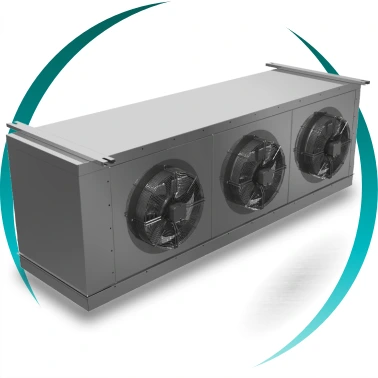
For cooling process fluid circuits (water, glycol, oil) without mains water consumption. Integrated refrigeration circuit with air condensation. Autonomous operation outdoors or indoors.
View technology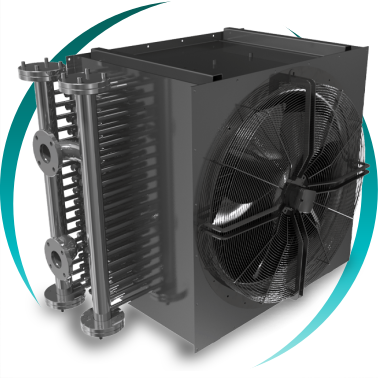
For heating or cooling industrial buildings, warehouses and production spaces. Uses steam, hot water or glycol as heat transfer fluid. Fast installation without civil works.
View technology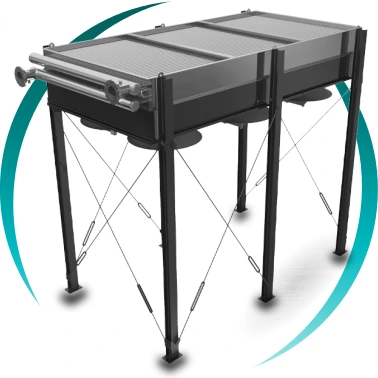
For dissipating heat from process circuits directly to the outdoor ambient. No refrigeration circuit. For cogeneration, compressors, transformers and heavy machinery.
View technologyFrequently asked questions about industrial fan-cooled equipment
What is the difference between a chiller, a unit heater and a dry cooler?
The chiller cools a process fluid with a refrigeration circuit; the unit heater conditions the temperature of a space; the dry cooler dissipates heat from a fluid directly outdoors without a refrigeration circuit.
All three types use forced air convection but serve very different purposes. The chiller incorporates a refrigeration circuit (compressor, air condenser, expansion and evaporator) to produce cold and cool a process fluid circulating in a closed circuit — it is the equivalent of a refrigeration circuit in an air conditioning unit, but for industrial use. The unit heater has no refrigeration circuit: it takes thermal energy from a heat transfer fluid (steam, hot water or hot glycol) and transfers it to the ambient air of a working space to heat it; in its cooling version, it reverses the process (cold glycol or chilled water to cool the space air). The dry cooler also has no refrigeration circuit: it takes heat from the process fluid (which may come from cogeneration, compressors or machinery) and dissipates it directly outdoors through a tube-and-fin battery with fans. The selection depends on whether the function is producing cold (chiller), conditioning a space (unit heater) or dissipating process heat (dry cooler).
Can fan-cooled equipment operate outdoors and in warm climates?
Yes, they can be designed for outdoor operation, but effective thermal capacity decreases as ambient temperature approaches the process fluid temperature.
All three units can be installed outdoors. The fundamental thermal limitation is that ambient temperature is the heat sink: as the ambient warms up (summer, warm climates), the ability to dissipate heat or cool the process fluid decreases. For installations in Mediterranean or arid climates, BOIXAC sizes equipment using maximum annual temperatures at the location (typically 35–40°C), not average temperatures. In very warm climates, the battery can be oversized, air flow increased (larger fans or fans in parallel) or an adiabatic pre-cooling system for inlet air can be added.
Does fan-cooled equipment require periodic maintenance?
Yes, mainly cleaning the heat exchange battery and checking the fans. The circuit does not require water treatment.
The main maintenance consists of periodic cleaning of the tube-and-fin battery, which can accumulate dust, cotton fibres, pollen or organic debris that reduce air passage and the transfer coefficient. In rural, agricultural or tree-lined environments, cleaning frequency may be high (every 3–6 months). Fans require bearing inspection and blade balance checks during extended operation. The great advantage over a cooling tower is that there is no open water circuit: no Legionella treatment is needed, no limescale builds up and there are no discharge risks. BOIXAC specifies the recommended maintenance plan in the technical documentation of each unit.
Can the output of fan-cooled equipment be regulated?
Usually yes, via variable frequency drive on fan motors, where rotation speed adjusts to actual thermal demand.
Power regulation is a standard feature in modern fan-cooled equipment. The main options are: (a) Variable frequency drive (VFD) on fan motors: enables continuous air flow adjustment based on the fluid or space outlet temperature, achieving significant energy savings at partial load. (b) Stage on/off control (on/off per fan in multi-fan units): step-by-step control, less energy efficient but more economical. (c) Variable blade pitch in high-efficiency axial fans: enables air flow adjustment without changing motor speed. BOIXAC specifies the appropriate regulation system for each application based on the process load profile.
What is the typical power range of industrial fan-cooled equipment?
From a few kW for building unit heaters up to tens of MW for dry coolers in cogeneration or heavy industry.
The power range is very wide and depends on the type. Unit heaters for industrial buildings cover 10 kW to 200–300 kW per unit, with several units installable in parallel. Industrial chillers with air condensation range from 5 kW to several hundred kW. Dry coolers for cogeneration, air compressors or heavy industry can reach 1 MW or more per unit, and are configured as multi-unit arrays for large-scale projects. BOIXAC analyses process thermal requirements and specifies the right solution in capacity, dimensions and configuration for each installation.
Can fan-cooled equipment replace a cooling tower?
In many cases yes, especially when eliminating water consumption and the risks associated with open circuits.
The dry cooler is the solution that directly replaces the cooling tower in heat dissipation circuits. The advantages over the tower are: zero make-up water consumption, elimination of Legionella risks and biocide treatment requirements, no discharges, lower maintenance and operation in cold climates without risk of open circuit freezing. The main limitation is that the minimum achievable process fluid temperature with a dry cooler is always above ambient temperature (typically 5–10°C above outdoor dry bulb temperature), whereas a cooling tower can reach temperatures 2–4°C above wet bulb temperature. In most industrial applications where the process admits the return temperature of a dry cooler, the replacement is direct and economically favourable.
Fan-cooled equipment projects specified by BOIXAC
- Dry coolers for cogeneration engine oil cooling in distributed energy production plants, with capacities of 200–800 kW per unit, configured for outdoor operation in Mediterranean climates
- Industrial unit heaters for heating logistics and food production buildings with low-pressure steam as heat transfer fluid, in installations of 1,000 to 5,000 m² of floor area
- Industrial chillers for hydraulic circuit cooling in heavy-tonnage press applications in the metalworking industry, with thermal oil circuits and air condensation outdoors
- Fan-cooled equipment for ATEX zones in chemical and petrochemical plants, with components certified for zones 1 and 2
Do you need fan-cooled equipment for your process or installation
The BOIXAC technical team analyses your process thermal requirements, the ambient conditions at the installation point, regulatory requirements and space constraints, and specifies the most suitable fan-cooled equipment type: chiller, unit heater or dry cooler.
We work with plant engineers, maintenance managers and industrial installers across Europe.