
Types of Heat Exchangers: Classification by Construction and Operation
Encyclopaedic guide to the main families of heat exchangers: from the distinction between direct and indirect contact to classification by fluid pair. Reference base for engineers, designers and technical managers.
There are many types of heat exchangers and multiple ways to classify them. This article classifies them according to classification by construction and classification by operation, which considers the fluid pairs involved and their physical properties.
1. Classification by construction
1.1 Direct contact
In direct contact heat exchangers, the two fluids are completely mixed. Cooling towers are the most representative example.
Fluid mixing can cause contaminant transfer between circuits. This makes direct contact unsuitable for most process cooling, energy recovery, gas treatment, food liquid and bulk solid systems where circuit separation is a technical or sanitary requirement.
1.2 Indirect contact
In indirect contact heat exchangers, the two fluids remain permanently separated by a physical element — usually a metal plate or tube wall — acting as the heat transfer surface without allowing any mixing. Focusing on the two main families — tubes and plates — a comparison can be drawn as follows.
Rotary heat recuperators are a special case within indirect contact. The two fluids traverse the same space alternately. A slight cross-contamination is theoretically possible, but in industrial practice is considered negligible.
| Feature | Tube heat exchangers | Plate heat exchangers |
|---|---|---|
| Compactness | Less compact for the same duty | High compactness: maximum surface in minimum volume |
| Transfer coefficient | Moderate, depending on tube and fin design | High thanks to turbulence induced by corrugations |
| Flow cross-section | Wide; less susceptible to fouling | Narrow channels; risk of blockage |
| Viscous / loaded fluids | Highly recommended. High tolerance to particles and viscosity | Unsuitable for dirty, viscous or sticky fluids |
| Maintenance and cleaning | Simple. Rarely clog; low maintenance cost | More susceptible to scaling; more frequent cleaning required |
| Dusty / abrasive environments | Excellent performance | Not well suited |
| Preferred application | Gas-gas, gas-liquid, liquid-liquid in demanding conditions | Liquid-liquid in clean, controlled circuits |
1.3 Tube heat exchangers
Tube heat exchangers consist of cylindrical, flat or oval tubes, the cross-section being selected according to the specific requirements of each system.
1.3.1 Bare tubes
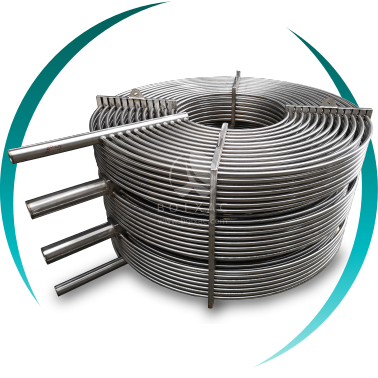
When the internal and external exchange surfaces are similar — fluids with comparable specific heats — bare tubes are used: bare-tube multi-tube exchangers for gas-to-gas, and tubular, multi-tube, shell-and-tube, coaxial or double-pipe, and fire-tube configurations for liquids.
1.3.2 Finned tubes
When the two fluids have very different specific heats — a common situation when one fluid is a gas and the other a liquid or steam — the exchange surface must be compensated by adding fins on the side of the fluid with lower specific heat.
The specific heat of gas (dry air) is approximately 1.214 kJ/m³·K, while that of water is 4.186 kJ/m³·K. Water can give up or absorb almost 3.5 times more energy per unit volume than air. To compensate for this imbalance, the exchange surface on the gas side is enlarged using fins.
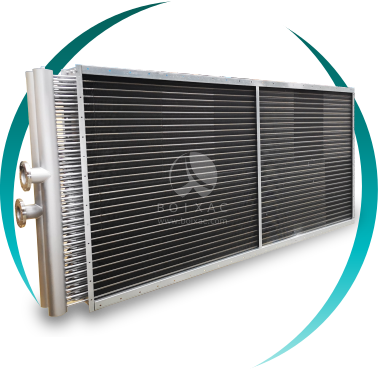
Continuous perforated sheets through which tubes pass perpendicularly. Uniform distribution of fin surface. Common in industrial HVAC and heat recuperators for exhaust gases with relatively clean air.
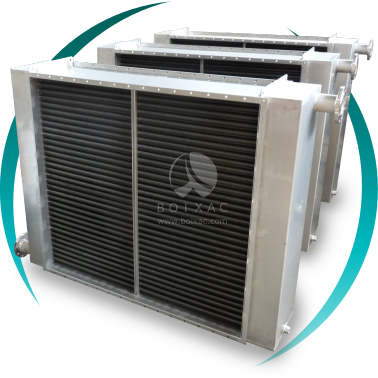
Sheets wound helically around each individual tube. Greater mechanical robustness and vibration resistance. Used for combustion gases, industrial fumes and streams with some particle content.
1.4 Plate heat exchangers
Plate heat exchangers consist of flat or corrugated plates acting simultaneously as heat transfer surface and as structural element of the flow channel.
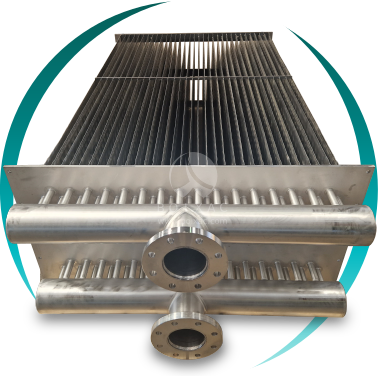
Emerging technology of great versatility. The cushion-shaped surface allows working with viscous, sticky and particle-laden fluids, and transferring energy to granular solids as an alternative to fluidised beds.
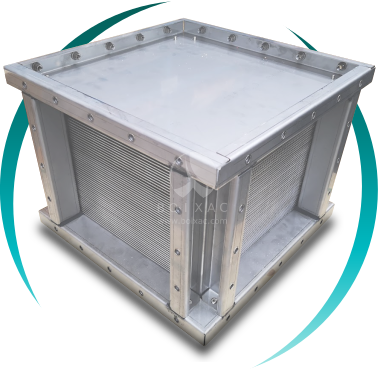
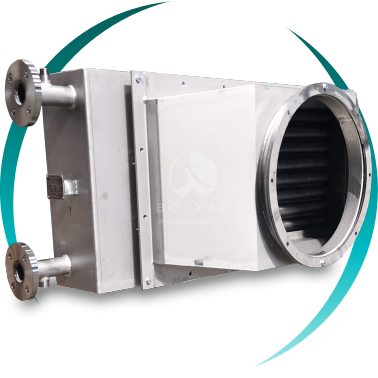
Plate system in perpendicular flow configuration, widely used in HVAC energy recovery. Achieves high efficiency values but requires advanced air filters due to the difficulty of internal cleaning.
Plates are joined by welding, forming a rigid assembly without gaskets. Internal cleaning is not possible; only applicable with completely clean fluids generating no scaling.
Gaskets allow individual plates to be dismantled, cleaned and replaced. More versatile than the welded type, but channels remain narrow and susceptible to blockage with viscous or particle-laden fluids.
2. Classification by operation
Classification by operation considers the fluid pairs involved and their physical properties. Correct selection is essential to maximise efficiency and ensure long-term installation reliability.
Gasketed plates · Concentric tubes
Coaxial · Shell-and-tube · Double pipe
Continuous finned tubes
Helical finned tubes
Heat recuperators
Cross-flow · Rotary
Flue gas recuperators
(alternative to fluidised beds)
2.1 Liquid–liquid heat exchangers
In applications where both fluids are liquids, specific heats are usually similar. Selection depends mainly on fluid viscosity, suspended particle content and operating pressures.
2.2 Liquid–gas heat exchangers
This is the situation where the difference in specific heats is most significant. Gas has a much lower specific heat than typical liquids, making it necessary to considerably increase the exchange surface on the gas side using fins.
2.3 Gas–gas heat exchangers
When both fluids are gases, their specific heats are similar. However, the low convection coefficient of gas makes it necessary to increase the total surface to achieve significant thermal duties.
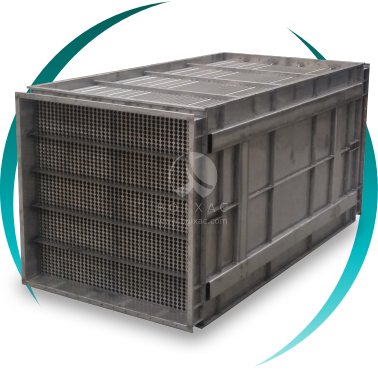
2.4 Bulk solid heat exchangers
Energy transfer to granular solids is a specialised field where the pillow plate exchanger has emerged as the reference technological alternative to conventional fluidised beds.
- Reduction in energy consumption compared to traditional fluidised bed systems
- Less product reject thanks to uniform heating or cooling
- Reduction of environmental pollution by eliminating or reducing the need for hot air as a thermal vector
- Improved product quality due to the absence of high thermal gradients
3. Selection criteria and design impact
Correct selection does not depend solely on the constructive family or the fluid pair. Small constructive details can significantly affect turbulence and heat transfer coefficients, resulting in substantial performance differences between manufacturers.
The definitive selection of a heat exchanger requires joint analysis of: process fluids, thermal duty and efficiency requirements, dimensional and weight constraints, installation and maintenance conditions, and applicable regulatory requirements (PED, ATEX where relevant). Investment in R&D is a key factor in the evolution of a sector increasingly recognised for its contribution to energy efficiency and industrial sustainability.